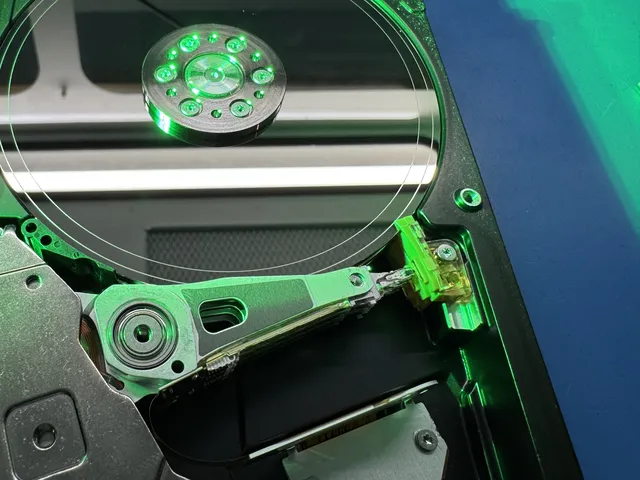
Recovery in progress on the bench
Drives arrive from all 50 states
the queue moves every day
345 Google Reviews · 2M+ Followers · Nationwide Service
Hard drive data recovery in Tallahassee should start with a lab evaluation, not another round of risky testing.
About this recovery service
MDRepairs is a real data recovery lab in New Jersey serving Tallahassee, Florida by mail with a free inbound label (contiguous US). We offer a $100 diagnostic applied toward the recovery, and no data, no charge. From Florida State University apartments and CollegeTown rentals to Midtown home offices, Southwood professionals, state government work near the Capitol, and small businesses across Leon County, we help Tallahassee customers send failed hard drives directly to the technicians who handle the recovery.
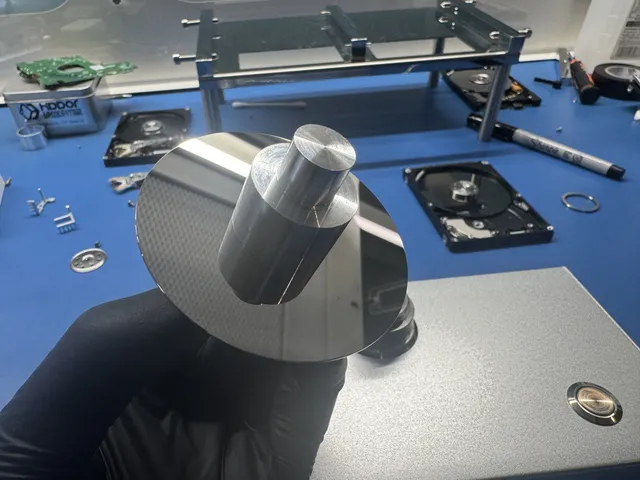
Real devices, real outcomes. Details generalized for customer privacy.
Recovery in progress on the bench
Drives arrive from all 50 states
the queue moves every day
Hard Drive Fell and making clicking sounds.
clicking on power-up
data recovered
Hard Drive recovery - HDD
failed device
data recovered
hdd - Toshiba - DTB 310 - 1TB
recovery requested
added to the engineer's queue
External Hard Drive Dropped and Now Making Noise
dropped, not spinning up
data recovered
Dropped Hard drive
dropped, not spinning up
data recovered
2007 imac hard drive clicking
clicking on power-up
data recovered
Recover data from clicking HDD
clicking on power-up
data recovered
Dropped My Hard Drive
dropped, not spinning up
data recovered
Next spot in the queue
Free UPS 2nd Day Air label (contiguous US), both ways
yours could be next
MDRepairs is an advanced hard drive data recovery lab - and we prove it on camera. Our lead technician Joseph Montanti documents real recovery cases from diagnosis to data delivery. Over 2 million followers across YouTube and social media watch us open failed drives, swap heads, rebuild firmware, and recover data that other labs couldn't.
More Recovery CasesThe people we help


 AT&T
 Marriott


 Tennessee Titans







Pick your device. You'll see what might be wrong, what to avoid, and whether it's urgent.
Mechanical - power it OFF now
That click is the read/write heads failing to find the platters - every extra minute of power risks the heads dragging across the surface that holds your data. Do not retry it, do not "test it one more time," and never open it outside a lab. This is exactly the failure our imaging bench exists for.
Serious - stop using it
A drive that spins but never appears usually has a firmware or electronics fault; one that is silent may have a dead PCB or seized motor. The good news: these are among the most recoverable failures when the platters have not been touched. Stop running detection tools that keep power-cycling it.
Mechanical - power it OFF now
A drop can park the heads on the platter surface or knock them out of alignment. Powering it up to "see if it still works" is how a recoverable drop becomes a scored platter. Leave it off - the evaluation tells you exactly what state it is in.
Logical - act calmly, act soon
Deleted or formatted data is usually still on the platters until something overwrites it. The one rule: stop using the drive right now - every download, update, and even browsing writes over your files. Recovery software CAN work here, but one wrong move on a failing drive makes it worse.
Mechanical - power it OFF now
Wet electronics corrode fast, but platters sealed inside the drive often survive floods and even fires. Do not rice it, bake it, or test it - seal it in a bag and get it to a lab. We handle storm-damaged drives from across the country every season.
Serious - stop using it
Freezes, endless load times, reallocated-sector warnings - that is a drive developing bad sectors faster than it can hide them. Back up what you can RIGHT NOW in one pass (no full scans, no defrag). If the backup stalls, stop and send it in before it degrades further.
Hard drive recovery starts at $1,000. We base your quote on what failed, the condition of the disks inside your drive, and any donor parts we need.
A $100 standard diagnostic - a hands-on assessment on professional tools, not a quick visual check. You approve a firm quote before any recovery work begins. The $100 is credited toward successful recovery and is non-refundable once diagnostics start. If the agreed target data cannot be recovered, there is no recovery fee; approved parts charges still apply.
Fill out the Get a Quote form for a more accurate estimate based on your specific situation.
Final price confirmed after diagnostic - no surprises.

Hard drive recovery pricing depends on what failed, how badly the drive is damaged, whether parts are needed, how the media reads, and how much data must be extracted. MDRepairs does not treat every Tallahassee case as the same job because a clicking drive, a corrupted partition, a dropped portable drive, and a platter-damaged disk are different recoveries. The process includes a $100 diagnostic that is applied toward recovery, with no data, no charge. Published ranges can include $1,000-$1,500, $1,500-$3,000+, $2,250-$3,500+, and higher for severe cases. Review data recovery cost details before shipping from Florida.
The standard wait is 4 to 6 weeks before we reach your device in line and start the diagnostic. Recovery takes additional time depending on what we find. Rush surcharges move your drive ahead of the standard diagnostic queue so assessment starts within the selected rush window. Confirm availability. Rush windows do not promise completed diagnosis or recovery.
4–6 weeks
No surcharge
We usually start the diagnostic in 4–6 weeks. Recovery time after that depends on your case. Standard service has no rush surcharge.
5–7 days
+$250
Diagnostic assessment starts within 5–7 days, ahead of the standard queue. Confirm availability.
1–2 days
+$500
Diagnostic assessment starts within 1–2 days, ahead of the standard queue. Confirm availability.
Same Day
+$1,000
Diagnostic assessment starts same-day, ahead of the standard queue. Confirm availability.
The standard wait to start the diagnostic is 4–6 weeks. Recovery takes additional time depending on the work your device needs. Rush surcharges advance the start of diagnostic assessment only; confirm availability. Shipping time is separate from diagnosis and recovery.
Once work starts, the failure type sets how long the recovery itself takes
Accidental deletion, formatting, corrupted partitions, and Seagate F3 / service-area faults. No mechanical intervention - typically the quickest turnaround once on the bench.
Burned or shorted controller boards from power surges. We repair the PCB and transfer the unique ROM - quicker than a head swap, slower than a clean logical case.
Clicking drives, crashed heads, seized motors, and scratched-platter cases need matched donor parts, controlled-environment work, and careful imaging. Donor availability depends on the exact drive.
Review the supplied shipping and return terms before sending the drive. Transit time is separate from diagnosis and recovery.
Standard hard drive recovery is measured in weeks because proper work can require diagnostics, parts matching, careful imaging, file system repair, extraction, and verification. MDRepairs does offer 1-day, 2-day, and 5-7-day rush options when a case qualifies, which can matter for a Tallahassee attorney, Florida agency employee, university department, production team, or small business waiting on critical files. Complex cases are quoted individually because damaged heads, weak media, scratched platters, firmware behavior, and donor availability can all change the schedule. The lab will not promise instant standard turnaround just to win the call.
Send your drive to our Lincroft, New Jersey lab after reviewing the supplied packing and shipping instructions. Confirm transit, return-shipping and delivery terms for your case.
Tell us about physical damage and previous repair attempts before sending the drive.
Describe the drive, symptoms and data you need. Review intake, diagnostic and shipping terms.
Follow the supplied packing instructions. Keep an external drive together with its original enclosure and parts.
The $100 diagnostic leads to an explanation of recovery options, limitations and a quote for your approval.
Confirm the result against your stated goal and agree delivery. The diagnostic is credited toward successful recovery.
MDRepairs serves Tallahassee, Florida by mail from its New Jersey lab. There is no claimed Tallahassee storefront, no rented local address, and no suggestion that the work is being done in Florida. The practical benefit is that your failed drive goes directly to the recovery lab instead of first sitting at a general computer repair counter that may outsource the job. You generate a free prepaid UPS label on the mail-in form (contiguous US), and overnight shipping from Tallahassee can reach the lab faster than many local handoffs.
The mail-in data recovery process is set up for internal hard drives, external USB drives, laptop drives, desktop drives, and individual disks from larger storage systems. Stop using the device, pack it so it cannot move in the box, and send only what the lab requests. Once received, MDRepairs evaluates the drive, explains the failure, and provides a quote before recovery proceeds. Customers can ship from downtown Tallahassee, Southwood, Frenchtown, CollegeTown, Killearn, Governor’s Square, or anywhere else in Leon County.
Agree the recovery goal, authorized access and delivery requirements before work starts.
Identify the types of data that matter without including private file contents in a quote.
Recovery involves handling data. Discuss access restrictions and any special requirements before service.
Agree how the result will be checked against your target data and how partial results are handled.
Agree the delivery method, format and any delivery media charges.
Ask about working-copy retention and the return of your original drive.
Review what was recovered, what remains unreadable and the available delivery format. Make a second copy of the delivered data.
Confirm the return or other handling of the original device with the lab. A failing drive should be retired from normal storage use.
Ask about opening files, compatible software and transferring supported data before assuming the result is a complete system backup.
Hard drives often contain far more than replaceable files. They may hold tax records, contracts, client folders, medical documents, student work, research files, employee records, saved application data, family photos, and business archives. MDRepairs treats privacy as part of the recovery process because the drive, forensic image, and recovered files all need controlled handling from intake through return.
That matters in Tallahassee because the city’s work often touches state government, Florida education, law, healthcare, nonprofits, campaigns, and private consulting. A failed disk from a home office near Midtown or a professional office near the Capitol can contain sensitive material even if the device looks ordinary. MDRepairs does not claim local partnerships or special Tallahassee affiliations. The concrete trust signals are a 4.6-star rating, 345+ Google reviews, PC-3000 and DeepSpar tools, ISO-grade cleanroom procedures, and a no data, no charge policy.
After a successful recovery, the failed hard drive should not go back into service. It has already shown that it cannot be trusted. MDRepairs returns recovered files on suitable replacement media or through an approved method based on the case, then Tallahassee customers can move that data into a healthier storage plan. That may mean restoring Florida State University coursework, legal documents, QuickBooks files, family photos, design work, video projects, or office folders to a new drive, NAS, or cloud backup.
Before deleting anything or recycling old hardware, review the recovered folders carefully. Open key documents, check filenames, and confirm that the highest-priority data is present. For cases beyond hard disks, MDRepairs also covers all data recovery services in Tallahassee.
Two ways to start: a free guided tool for drives that are safe to try at home, or a real $100 lab diagnostic - device-appropriate assessment, credited toward your recovery if you proceed.
A free initial quote explains how to start. The $100 lab diagnostic assesses your drive and supports a recovery quote for approval. It is credited on success; diagnostic and approved parts charges apply on failure. Confirm any special work or delivery terms before approval.
Failed mechanics are assessed and stabilized before any imaging - seized motors, crashed heads, and stiction diagnosed by hand.
Industry-standard ACE Laboratory hardware reads firmware modules, SMART data, and the service area to map exactly how the drive failed.
Open-platter work happens on a clean laminar-flow bench with write-blocked, sector-by-sector imaging to a healthy donor disk.
You receive a clear assessment of the failure, recovery options with firm pricing, and the limitations of the proposed work.
Our free DIY hard drive recovery tool guides you through your drive's symptoms - clicking, beeping, or a drive that won't show up - then gives you tailored, step-by-step recovery instructions for drives that are safe to try at home. No downloads, no sign-up. If your situation calls for the lab instead, the tool will tell you that too.
Watch real hard drive recoveries from start to finish - every diagnosis, repair, and data extraction documented on camera.
We cover the UPS label and the trip home in the lower 48, except islands. $100 diagnostic, credited toward a successful recovery. If we can't get any files back, there's no recovery fee.
Affirm financing, if eligibleHard drive data recovery is the process of retrieving inaccessible, lost, or damaged data from a hard disk drive that has failed mechanically, electronically, or logically - including dead hard drives that won't power on or be detected by your computer.
Hard drives store data magnetically on spinning platters using read/write heads that float nanometers above the surface. When components fail - heads crash, motors seize, PCBs burn out, or firmware corrupts - your files become trapped on the platters. Hard disk drive recovery is the process of bypassing or replacing those failed components to extract your data.
Our lab uses ACE Laboratory's PC-3000 for firmware diagnostics, head map editing, and service area repair, and DeepSpar imaging hardware for extracting data from physically damaged media. Our lab also has a laminar flow bench and a donor drive library spanning all major manufacturers. We copy the drive's readable sectors before working on your files.
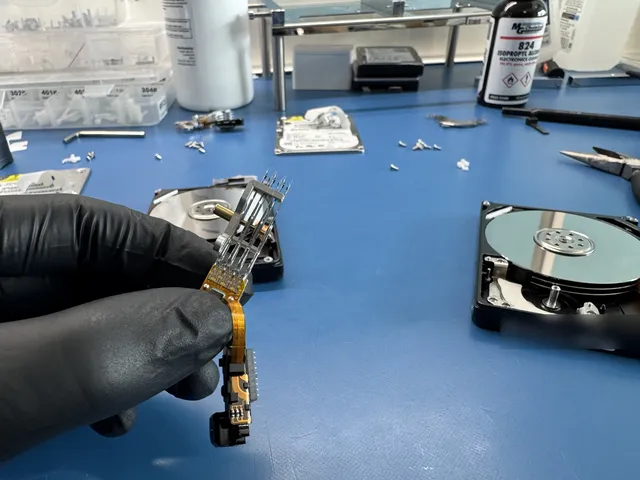
Understanding the internal components of a hard drive helps explain why different failures require different recovery approaches - and why some are more expensive than others.
Magnetic-coated disks where data is physically stored. Scratched platters mean permanently destroyed data, making scratched platter recovery the most difficult type of data recovery.
Fly nanometers above spinning platters to read and write data. Failed heads can crash into the platter surface, destroying data and causing the clicking sound heard from failing drives.
Spins the platters at thousands of RPM. A seized motor causes beeping or buzzing and requires transplanting the platters to a donor motor assembly.
The external board controlling all drive operations. Contains unique calibration data, which is why swapping PCBs between drives doesn't work without a ROM transfer.
Internal software stored on the platters that maps where data is physically located. Corruption can cause the drive to go undetected or hang during startup.
Amplifies signals from the heads to the PCB. Failure mimics head failure (clicking, read errors) and requires a full head stack replacement.
Hard drive recovery is the careful process of extracting files from a hard disk that can no longer be trusted. In Tallahassee, that may be a laptop drive from a Florida State University student that suddenly asks to initialize, an external backup from a Midtown home office that clicks, a desktop drive used by a law firm near downtown that freezes the computer, or a storage disk from a small business around Capital Circle that no longer appears correctly. The common thread is that the storage device is failing, corrupted, damaged, or unstable, and normal computer repair steps can make the situation worse.
MDRepairs handles hard drive repair and recovery as a lab service. In this context, repair does not mean making the old drive reliable again for daily use. It means stabilizing the device only as much as needed to image the media, work around bad areas, and extract the data. A hard drive with weak heads, degraded platters, bad sectors, firmware problems, damaged electronics, or a seized motor needs a different approach than a healthy disk with a software problem.
That distinction matters for anyone searching for data recovery in Tallahassee FL. A nearby storefront may be convenient, but the real question is whether the drive will be handled in a lab workflow or sent out after intake. MDRepairs is direct about its model: the lab is in New Jersey, and Tallahassee, Florida customers use mail-in service to get the device to the people doing the work. The process is built around controlled diagnostics, proper imaging, and clear recovery quotes.
For physical cases, MDRepairs uses ISO-grade cleanroom procedures when internal drive access is required, along with professional tools such as PC-3000 and DeepSpar imaging systems. Those tools help technicians manage drives that drop offline, read slowly, report unstable sectors, or behave unpredictably during normal copying. For logical cases, including deleted files, damaged partitions, corrupted file systems, accidental formatting, or drives that mount but show missing folders, the lab still works from an image whenever possible so the original media is not repeatedly stressed.
Tallahassee has a mix of university work, public-sector records, legal documents, healthcare files, nonprofit data, family photos, research material, video projects, and everyday small business records. A failed hard drive from a home near Killearn, a workstation near Cascades Park, or an office serving Florida clients may hold the only copy of important files. You can review broader Florida hard drive recovery coverage, including Miami recovery, Tampa recovery, and Orlando recovery, but this page is specifically for Tallahassee hard drive recovery by direct mail-in to the lab.
Every hard drive failure has a cause. Identifying the symptoms correctly is the first step toward successful data recovery - and knowing what NOT to do is just as important.
Repetitive clicking means the read/write heads are failing - they're trying to load onto the platters and falling back. Each click cycle risks scratching the platter surface and destroying data permanently. See our clicking hard drive recovery service.
Power off immediately. Do NOT restart.
Beeping indicates the spindle motor cannot spin the platters - either the motor has seized or the heads are stuck to the platter surface (stiction). The drive needs physical intervention to free the mechanism. Learn more about beeping hard drive recovery.
Power off immediately. Do NOT shake the drive.
If your drive spins but isn't recognized, the issue is likely firmware corruption, a failed PCB (circuit board), or damaged service area on the platters. If the drive doesn't spin at all, the motor or PCB may have failed. We handle drives not detected by the computer, including external hard drives that no longer mount.
Stop reconnecting. Each attempt may worsen firmware damage.
Liquid exposure causes rapid corrosion on the circuit board, heads, and internal components. Fire-damaged drives face heat warping and smoke contamination. Both require urgent professional attention.
Do NOT power on. Do NOT dry with heat. Ship immediately.
If you deleted files, emptied the recycle bin, or accidentally formatted a drive, the data likely still exists on the platters - it's just no longer indexed by the file system. Our guide on how to recover deleted files from a hard drive explains why recovery is very possible if you stop writing to the drive.
Stop using the drive. Do NOT install recovery software on it.
If the drive shows no signs of life - no spinning, no LED, nothing - the PCB (circuit board) has likely failed, often from a power surge, bad power supply, or damaged SATA/USB port. The platters and data are usually fine.
Do NOT swap PCBs from another drive without professional guidance.
Not sure what's wrong? Try our free HDD Diagnostic Tool for a guided assessment, or call 732-933-7717 to speak with a technician.
Run the Diagnostic ToolHard drive failures fall into two main categories. Understanding which type your drive is experiencing determines the recovery approach, timeline, and cost.
Failed read/write heads are replaced using matched donor heads from an identical drive model. Performed in a controlled, particle-filtered environment to protect the platter surface.
Seized spindle motors require platter transplant to a donor chassis. Stiction (heads stuck to platters) requires manual head unsticking using specialized tools under magnification.
When heads contact the spinning platter surface, they create circular scratches that destroy data in those zones. Our scratched platter recovery works around damaged areas to image recoverable sectors.
Dead motor, failed PCB, or damaged preamp. We diagnose the exact point of failure and either replace the component or transplant platters to a functional assembly.
Physical impact displaces the head assembly, damages the preamp, or causes immediate head crash. Severity depends on whether the drive was spinning at impact. Never power on a dropped drive.
Deleted data remains on the platters until overwritten. We image the drive at the sector level and use file carving and file system reconstruction to recover files, folders, and directory structures.
NTFS, HFS+, ext4, and other file systems can become corrupted from improper shutdown, power loss, or bad sectors. We reconstruct the file system metadata to restore access to your data.
Hard drives run internal firmware stored in a service area on the platters. When this firmware becomes corrupted - from bad sectors, power events, or manufacturing defects - the drive may not be detected or may lock up during initialization. PC-3000 tools allow us to read and patch firmware modules.
Degrading magnetic media causes bad sectors that grow over time. SMART warnings indicate the drive is failing. We create a forensic image that works around bad sectors, reading good data first and returning to problematic areas with multiple passes.
Power surges, bad adapters, or component failure can kill the drive's circuit board. PCB recovery requires transferring the original drive's ROM/firmware chip to a compatible donor PCB - swapping boards without this step will not work on modern drives.
Not all hard drives fail the same way. Each manufacturer and drive family has specific failure patterns that require specialized knowledge and tooling. Our technicians maintain current expertise across all major families.
Seagate Rosewood drives (common in Barracuda and Backup Plus models) are known for LED error codes and terminal lock states where the drive becomes completely unresponsive. Recovery requires PC-3000 terminal access to unlock the service area and rebuild corrupted firmware modules before data can be imaged.
Western Digital SMR (Shingled Magnetic Recording) drives use overlapping write tracks to increase density. This makes the translator tables - which map logical to physical sectors - extremely fragile. If the translator corrupts, the drive appears empty or unreadable despite intact data underneath.
High-capacity helium-sealed drives (8TB+) from Seagate, WD, and HGST use helium gas instead of air to reduce turbulence and pack more platters. We cut open the sealed enclosure, replace the failed head stack, then inject lab-grade helium while actively reading the platters - allowing us to image the drive before the gas dissipates.
Older Seagate F3-family drives store firmware across multiple heads. When one head degrades, the drive enters a busy state or fails initialization. PC-3000 allows us to selectively disable damaged heads, patch firmware, and rebuild system files to regain access.
Western Digital drives using Marvell controllers store critical calibration data in the PCB ROM chip. If the PCB fails, the ROM must be carefully desoldered, read, and transferred to a compatible donor board. Without this step, the donor PCB will not initialize the drive correctly.
Higher capacity drives (2TB, 4TB, 8TB+) pack more data onto the same platter area using higher areal density. This means tighter head tolerances, more sensitive alignment, and less margin for error during head swaps. Recovery from high-capacity drives requires extremely precise donor matching and extended imaging times.
We maintain donor drive inventory and brand-specific tooling for every major hard drive manufacturer. Each brand has unique firmware architectures, head designs, and failure patterns that require specialized knowledge.
We assess Seagate hard drives. We service Barracuda, IronWolf, Backup Plus, Expansion, One Touch, FireCuda, Exos, and SkyHawk. Seagate's F3 firmware architecture is prone to busy states, failed initialization, and capacity misreporting when heads degrade. The Rosewood platform frequently presents LED error codes and terminal lock states requiring PC-3000 serial terminal access to unlock.
Seagate Recovery DetailsWe assess Western Digital hard drives. We recover My Passport, My Book, Elements, easystore, WD Blue, Black, Red, Purple, Gold, and Ultrastar drives. Modern WD drives use Marvell controllers with ROM chips containing unique calibration data - PCB swaps without ROM transfer will fail. WD's SMR drives are especially vulnerable to translator corruption from power loss.
WD Recovery DetailsCovers the Canvio Advance, Canvio Slim, Canvio Ready, P300, X300, N300, and MG enterprise series. Common failures include head degradation on Canvio 1TB-2TB models and firmware hang states where the drive spins up but never completes initialization. Toshiba's firmware architecture requires brand-specific PC-3000 modules for service area access.
Toshiba Recovery DetailsDeskstar, Travelstar, Touro, and Ultrastar drives are among the most reliable ever made but still fail from gradual head degradation, preamp failure, and motor bearing wear. HGST firmware requires its own diagnostic approach separate from WD despite the 2012 acquisition. Donor head matching requirements differ from Western Digital drives.
Hitachi Recovery DetailsSamsung exited the HDD market in 2011, but Spinpoint F3 desktop drives and Spinpoint M8/M9T portable drives remain widely in use. Common failures are head degradation, motor seizure, and PCB failure. Samsung firmware requires Samsung-specific PC-3000 modules and Samsung-only donor heads - Seagate parts are not compatible.
Both brands are now Seagate subsidiaries - modern LaCie Rugged, d2, and 2big drives contain Seagate mechanisms and use F3 firmware tools for recovery. Legacy Maxtor drives (DiamondMax, OneTouch) require Maxtor-specific donors. LaCie Rugged drives are popular with photographers and videographers but share the same failure patterns as any Seagate drive.
MDRepairs works with hard drives from major manufacturers commonly found in Tallahassee homes, offices, university systems, backup enclosures, DVRs, and workstations. Brand alone does not decide the recovery path. A Western Digital external drive that disconnects, a Seagate desktop drive that clicks, a Toshiba laptop drive with bad sectors, an HGST enterprise disk from a server, and a Samsung branded external drive can all require different handling.
The lab evaluates the actual symptoms, model family, firmware response, head condition, media condition, electronics, enclosure bridge, capacity, and prior recovery attempts. Some external drives hide a SATA disk behind a USB bridge board, while others use native USB electronics that require different handling. That is why hard drive repair Tallahassee searches should lead to a real diagnostic, not a flat answer based only on the label. Florida customers get the same lab process whether the drive came from Tallahassee, Miami, Tampa, Orlando, or a rural office outside the city.
Some hard drive data loss scenarios can be handled at home. Others require professional intervention - and attempting DIY on a mechanically failing drive can make things worse. Here's how to know the difference.
Try our free HDD Diagnostic Tool to check if DIY is appropriate for your situation.
Every power cycle on a failing drive risks permanent damage. Call 732-933-7717 or get a free quote.
Before spending money on professional recovery, there are a few safe checks you can run at home - and a few things you should absolutely never do. Here's the difference.
Well-intentioned DIY attempts can cause additional damage and further corrupt the hard drive. Avoid these mistakes to keep from doing more damage.
Even a few seconds of platter exposure in normal room air introduces dust and fibers that cause head crashes. Opening a drive also risks scratching the platters and disturbing head alignment. If a drive arrives already opened, recovery becomes significantly harder - and sometimes impossible.
This internet myth does not work on modern drives. Freezing introduces condensation inside the drive, accelerating corrosion of the heads and platter surface. Thermal shock can also crack glass platters. A clicking drive will still click after the freezer - now with water damage added.
Repeated attempts can worsen a mechanically failing drive. Stop after new repetitive clicking, grinding or unstable detection and seek an assessment.
Modern PCBs contain a ROM chip with calibration data unique to each drive. Swapping without ROM transfer results in no detection at best - at worst it sends incorrect values to the heads, causing them to contact platters at the wrong position.
Recovery software like Recuva or Disk Drill is designed for healthy drives with logical damage. Running it on a mechanically failing drive forces thousands of read commands, degrading heads further with every retry. If your drive makes unusual sounds, do not run software on it.
Hard drive failures worsen over time. Mild head degradation today becomes catastrophic failure next month. Water-damaged drives corrode more every day. Drives with growing bad sectors lose more data progressively. The best time to send a failing drive for recovery is now.
Hard drives rarely fail without warning. Recognizing these early signs gives you time to back up your data before a catastrophic failure - or to get it to a recovery lab before things get worse.
Sluggish file access, long boot times, and random freezes often mean the drive is developing bad sectors and the heads are struggling to read degraded platter areas.
Your drive's built-in monitoring has flagged critical health metrics - reallocated sectors, pending errors, or seek failures. Back up immediately.
A drive that vanishes and reappears signals a failing PCB, unstable connection, or intermittent head failure - progressive problems that become permanent.
Clicking, grinding, beeping, or buzzing from your drive means mechanical components are failing. A healthy drive is nearly silent - new sounds demand immediate action.
Garbled documents, broken images, and BSODs during disk operations mean the drive is losing the ability to read its platter surface - and it accelerates over time.
Experiencing any of these? Read our in-depth guide to hard drive failure, try our free HDD Diagnostic Tool, or call 732-933-7717 to speak with a technician.
The biggest mistake after a hard drive fails is continuing to test it. If the drive clicks, beeps, grinds, spins down, runs extremely slowly, disappears during copying, or freezes the computer, shut it down. Do not put it in a freezer, tap it, open the cover, swap boards at random, run CHKDSK, initialize it, format it, or install recovery software onto the same disk. Those steps can overwrite file system structures or force damaged heads across the platter surface.
For Tallahassee customers, the safest move is to separate the computer problem from the data problem. A campus IT helper, a neighborhood repair shop, or a well-meaning friend may be able to solve a normal software issue, but a physically failing drive needs lab imaging. If the files matter, call 732-933-7717 before another power cycle.
Some symptoms mean the drive should be treated as urgent. Clicking, grinding, buzzing, burning smell, liquid exposure, repeated disconnects, a request to format, a drive showing 0 bytes, or a computer that freezes whenever the disk is attached can all point to worsening damage. A hard drive can also be failing while sounding normal, especially when bad sectors are spreading or firmware is unstable.
Be careful with any Tallahassee hard drive recovery offer that guarantees results, quotes a severe mechanical case without seeing the drive, or advertises every diagnostic as free when the actual process says otherwise. MDRepairs uses a $100 diagnostic that applies toward recovery, no data means no charge, and recovery work is quoted after evaluation. For Florida customers who need a straight answer, that is more useful than a promise made before the drive has been examined.
These are not the same service - and confusing them can cost you your data.
Hard drive repair means fixing the drive so it can function as a working storage device again - spinning, reading, and writing data normally. In the vast majority of cases, this is neither possible nor advisable.
A hard drive that has suffered mechanical failure (clicking, beeping, head crash) cannot be reliably returned to service. Even if it appears to work after a temporary fix, the underlying damage means it will fail again - potentially destroying data that was recoverable the first time.
Some shops advertise "hard drive repair" and may attempt fixes that prioritize getting the drive to boot - like running CHKDSK, attempting firmware hacks without proper tools, or even opening the drive without a controlled environment. These approaches can permanently destroy data that a professional lab could have recovered.
Hard drive data recovery means extracting the data from a failed drive and transferring it to healthy media. The original drive is not repaired for continued use.
The real repair work still happens here: PCB replacement with firmware chip transfer, service-area firmware repair, and clean-bench head stack swaps are genuine hard drive repairs, and they are steps inside nearly every mechanical recovery we perform. The difference is the goal: we repair the drive so it can give up your data, not so you keep trusting a drive that already failed once.
Our technicians stabilize the drive just enough to create a complete sector-level image of the platters, extract your files from that image, and deliver them on a new external drive or via secure download. The goal is your data, not a working drive.
The correct approach is always: image first, extract data second, and retire the failed drive permanently.
At MDRepairs, we never return a failed drive to service. We recover your data, deliver it on new media, and the original drive is either returned to you or securely destroyed per your instructions.
A computer repair shop and a data recovery lab solve different problems. Repair shops are useful when a laptop needs a screen, Windows will not boot, a cable failed, or a machine needs cleanup. A hard drive recovery lab is for cases where the storage device itself is unstable, damaged, corrupted, or unreadable through normal tools.
For hard drive recovery near Tallahassee, the question is not only who is closest. It is who will avoid unnecessary writes, image weak media with professional tools, open the drive only under proper conditions, and explain the quote before recovery proceeds. MDRepairs is a New Jersey lab serving Tallahassee, Florida by mail, with a free inbound label (contiguous US), $100 diagnostic, PC-3000 and DeepSpar tools, ISO-grade cleanroom procedures, 4.6 stars with 345+ Google reviews, and no data, no charge.
Clicking, beeping, or not detected? Power it off and get a free quote - every power-on risks the platters.
Affirm financing, if eligibleWe've earned our reputation one recovery at a time - with full transparency, honest pricing, and results we document on camera.
We diagnose your drive, explain your options, and give you a quote. We start recovery only if you approve.
We perform head-stack swaps, motor and stiction repair, and controlled-environment platter work - recovering drives that other shops return as "unrecoverable," including complex scratched-platter cases.
If we cannot recover your data, the $100 diagnostic and approved parts charges still apply, but there is no recovery fee. Confirm any special work and delivery terms in the written quote. Your approval is required before any recovery work begins.
We run industry-standard PC-3000 hardware by ACE Laboratory and keep a deep inventory of donor heads, boards, and firmware modules - so we can match parts to your exact drive and image it sector-by-sector.
Recovery work takes place at our Lincroft, New Jersey lab. Agree data access, verification, delivery and retention requirements before service.
Based at 644 Newman Springs Road in Lincroft, NJ, we serve clients in all 50 states through our secure mail-in program with shipping terms supplied for your case. Get a quote or call 732-933-7717.
We recover data from hard drives in any configuration, from any operating system, in any enclosure or computer.
The file system on your drive determines the recovery approach. NTFS and HFS+ are the most common and have well-understood structures. Newer file systems like APFS and ReFS are more complex but fully supported by our tools.
External drives use the same internal mechanisms as desktop/laptop drives inside a USB enclosure. Sometimes the external enclosure fails while the internal drive is fine - we test for this during diagnostics before recommending a full recovery.
An external hard drive spun without unusual noises but would not initialize. The documented work included replacing read heads and preserving firmware information needed to access the data. Most of the data was recovered, with some unreadable data remaining.
This is one individual recovery, not a forecast for another drive. Quiet operation alone does not establish that a drive is healthy, and a partial recovery is different from a complete result.
RAID arrays and NAS devices add complexity to hard drive data recovery - but the core principles are the same. RAID (Redundant Array of Independent Disks) systems use multiple hard drives working together for performance, redundancy, or both. NAS (Network Attached Storage) devices like Synology, QNAP, and WD My Cloud typically use RAID configurations internally.
When a RAID array fails, recovering data from RAID drives requires understanding both the individual drive failures and the RAID configuration that ties them together.
Data is split across two or more drives with no redundancy. If any single drive fails, the entire array is lost. Recovery requires imaging the failed drive (or drives) individually and then reconstructing the stripe order and block size to rebuild the virtual volume.
Two drives contain identical copies of the data. If one drive fails, the other should contain a complete copy. Recovery is typically straightforward - we image the surviving drive. If both drives fail, we recover whichever is in better condition.
Data and parity information are distributed across three or more drives. The array can tolerate one drive failure and rebuild from parity. When two or more drives fail simultaneously - or when a rebuild operation triggers a second failure - recovery requires imaging all available drives and using parity calculations to reconstruct the missing data.
RAID 6, RAID 10, and other configurations have their own redundancy models and failure characteristics. We handle all RAID levels.
RAID recovery pricing depends on the number of drives, the RAID configuration, and the failure mode. Single-drive failures within a RAID are priced as standard hard drive recovery. Multi-drive failures and array reconstruction add complexity and cost. For businesses relying on NAS or server storage, our partnership program provides priority scheduling and dedicated support for RAID recovery cases.
Every recovery begins with a $100 diagnostic evaluation - external inspection, PCB testing, motor current analysis, and controlled spin-up with head monitoring. We give you an estimate based on what we found. It includes the expected timeline.
The $100 diagnostic is credited on success; diagnostic and approved parts charges apply on failure or you decline. Severely scratched or damaged drives requiring advanced inspection have a $500 diagnostic deposit. Describe severe platter damage or previous opening before intake, and confirm how the deposit is applied before authorizing special work.
Not sure where to start? Try our free hard drive diagnostic tool.
ACE Laboratory PC-3000 for firmware diagnostics, head map testing, selective head disabling, and controlled imaging with configurable retry strategies.
Particle-filtered environment for head swaps, platter transplants, and internal inspection. The controlled work area helps limit airborne contamination.
Extensive donor library across all major manufacturers and firmware revisions - Seagate, WD, Toshiba, and Hitachi.
Full chain of custody from intake through data return - the same standard used by forensic recovery operations.
$100 diagnostic, credited toward a successful recovery. If we can't get any files back, there's no recovery fee. Call us directly at 732-933-7717 or get started online. We cover the UPS label and the trip home in the lower 48, except islands.
We serve these cities through our secure mail-in program. We cover the UPS label and the trip home in the lower 48, except islands.
Looking for hard drive data recovery elsewhere in Florida? View all hard drive data recovery cities in Florida, or visit our main hard drive data recovery page.
No question matches that - it's probably faster to just ask us: (732) 933-7717 or .
The statistics, specifications, and claims on this page are sourced from publicly available data. We cite our sources so you can verify independently.
Annualized failure rate data from a monitored fleet of 340,000+ drives. Model-level reliability data referenced for general manufacturer failure trends and the ~1.5-1.6% average annualized failure rate cited on this page.
Industry-standard data recovery hardware and software used by professional labs worldwide including DriveSavers, Ontrack, and Rossmann Repair Group. Manufacturer specifications referenced for tool capabilities described in our recovery process.
Professional sector-level imaging tool with controlled retry and timeout features. Used in conjunction with PC-3000 for forensic-grade imaging of failing drives.
International standard for classifying air cleanliness in cleanrooms and clean zones. We cite this standard when comparing air cleanliness at a clean bench and in an enclosed workspace.
U.S. National Institute of Standards and Technology guidelines confirming that a single-pass overwrite is sufficient for modern magnetic media. Referenced in our FAQ on overwritten data recovery.
Federal law prohibiting manufacturers from voiding warranties solely because an independent service provider performed repair or recovery. Referenced in our FAQ on whether data recovery voids your warranty.
Quarterly reports breaking down failure rates by manufacturer and model. Referenced for Seagate, WD, Toshiba, and HGST failure trends discussed in our manufacturer sections.
Keep 3 copies of your data, on 2 different types of media, with 1 copy stored offsite or in the cloud. This is the industry standard for data protection and guards against drive failure, theft, fire, and ransomware.
Use free tools like CrystalDiskInfo (Windows) or DriveDx (Mac) to check your hard drive's SMART status regularly. Reallocated sectors and pending errors are early warnings that a drive is failing - back up immediately if you see them. Read our complete guide on how to check hard drive health for step-by-step instructions on Windows, Mac, and Linux.
Hard drives have a typical lifespan of 3-5 years under normal use. If your drive is older than 4 years or shows any SMART warnings, replace it proactively and clone your data to the new drive before the old one fails completely.
Already experiencing symptoms? Try our free HDD Diagnostic Tool or call 732-933-7717 .
Educational resources to help you understand hard drive data recovery, make informed decisions, and protect your data.
If your hard drive is mechanically healthy (spinning normally, no unusual sounds, detected by your computer), you may be able to recover data using software tools. Start by connecting the drive as a secondary device - do not boot from it, as the operating system may overwrite deleted data. Use a read-only recovery tool like R-Studio, Recuva, or PhotoRec to scan the drive and extract files. Never install recovery software onto the failing drive itself. If the drive is not detected, makes unusual sounds, or shows SMART errors, skip software and contact a professional lab to avoid causing further damage. Our free HDD Diagnostic Tool can help you determine which approach is right for your situation.
A "dead" hard drive - one that won't power on, isn't detected, or shows no signs of life - usually has a PCB (circuit board) failure, seized motor, or severe firmware corruption. Do not assume the data is gone. The condition of the platters must be assessed; a dead appearance does not establish either total loss or a complete recovery. Recovery involves diagnosing the specific failure point (burned TVS diode, failed motor controller, corrupted service area) and bypassing or replacing the failed component to access the platters. Read our full guide on how to recover data from a dead hard drive for step-by-step guidance on what to try and when to contact a professional lab.
Deleted-file recovery depends on overwrite, drive behavior and the method used to delete or format the data. When you delete a file, the data stays on the magnetic platters until new data overwrites it. Our complete guide covers how to recover deleted files from a hard drive, why hard drives are the most recoverable storage type for deletion cases, and what steps to take right after accidental deletion.
Software recovery tools like Recuva, R-Studio, and PhotoRec work well for logical failures on mechanically healthy drives - accidentally deleted files, formatted partitions, and corrupted file systems. If your drive spins normally, makes no unusual sounds, and is detected by your computer, software is a reasonable first step. However, if the drive is clicking, beeping, not spinning, or not detected, software cannot help - and running it can make things worse by forcing failing heads to sweep across degrading platters. Repeated attempts on a failing drive can reduce the remaining recovery options. Published logical recovery starts at $1,000; advanced platter work can cost $2,250+. When in doubt, try our free HDD Diagnostic Tool to determine whether DIY software or professional lab recovery is right for your situation.
Choosing a data recovery service is a high-stakes decision - you're trusting someone with data that may be irreplaceable. Here are the key questions to ask:
If you're searching for the best hard drive data recovery near your location, physical proximity matters less than specialized capability. Most local computer repair shops and IT consultants lack the equipment for mechanical hard drive recovery - they'll either attempt software-only recovery (which won't help with mechanical failures) or broker your drive to a specialized lab, adding markup and transit time.
Mailing your drive directly to a specialized lab like MDRepairs eliminates the middleman. Review the supplied shipping terms and current timing estimate and ask about communication with the technicians who actually handle your case. MDRepairs serves customers in all 50 states from our Lincroft, NJ facility. You can mail your drive from New York City, Texas, Florida, California, Maryland, Pennsylvania, Illinois, Georgia, or any other state. We cover the UPS label and the trip home in the lower 48, except islands. We use UPS 2nd Day Air both ways. On each trip, you can expect delivery by the end of the second business day after UPS gets your box. Weekends and holidays don't count. Our lab uses PC-3000 for diagnostics and keeps donor drives on hand. When we open a hard drive, we work in a laminar flow cabinet.
Rush surcharges move your drive ahead of the standard diagnostic queue so assessment starts within the selected window: Priority 5–7 days (+$250), Urgent 1–2 days (+$500), or Emergency same-day (+$1,000). Confirm availability. These windows do not promise completed diagnosis or recovery. The standard wait is 4 to 6 weeks before we reach your device in line and start the diagnostic. Recovery takes additional time depending on what we find. See our contact options.
External hard drives are among our most common recovery cases. Whether your Seagate Backup Plus, WD My Passport, Toshiba Canvio, LaCie Rugged, or other external drive was dropped, stopped being recognized, or is making clicking sounds, we recover the data using the same professional process we apply to internal drives. External enclosure failures are evaluated separately - sometimes the drive inside is fine and only the USB controller board has failed, making recovery straightforward and inexpensive. We recover data from all external drive brands and connection types including USB 3.0, USB-C, Thunderbolt, FireWire, and eSATA.
For business data, define the recovery goal and who can authorize access. Discuss any required documentation or forensic preservation before work begins; a standard recovery does not automatically meet a particular compliance or evidence standard. See our partnership program.
If you manage IT infrastructure or run a technology services business, our partnership program offers priority scheduling, volume pricing, and dedicated account management for hard drive data recovery cases. Many managed service providers and IT consultants refer their hard drive recovery work to MDRepairs because we handle the specialized work they cannot perform in-house - board-level micro-soldering, controlled-environment head swaps, firmware repair, and forensic imaging are capabilities that most IT shops and MSPs do not maintain. We provide white-label reporting and direct-to-client delivery when needed.
MDRepairs is a specialized data recovery lab based in Lincroft, New Jersey, serving customers nationwide through our mail-in program. Our lab is equipped with ACE Laboratory PC-3000, DeepSpar imaging hardware, a HEPA-filtered laminar flow bench, and an extensive donor drive library spanning all major manufacturers. The assessment explains the proposed work and the limits of the available recovery path. If we can't get any files back, there's no recovery fee. The $100 diagnostic is non-refundable once diagnostics start, and donor drives or replacement parts you approve are non-refundable once ordered, even if recovery fails. Before you pay for recovery, you can look through your report to see which files we got back.
Beyond hard drive data recovery, MDRepairs provides professional data recovery services for a wide range of devices. We offer SATA SSD data recovery, NVMe SSD recovery, iPhone data recovery, Samsung Galaxy data recovery, cell phone data recovery for all brands, flash drive and USB recovery, SD card recovery, laptop data recovery, MacBook data recovery, iPad data recovery, and iPod data recovery. After recovery, learn how to transfer data to your new phone or access your recovered data through our secure portal.
Ready to recover your hard drive data?
MDRepairs serves Tallahassee and surrounding areas from our dedicated data recovery lab in Lincroft, New Jersey. Tallahassee customers in Downtown Tallahassee, Midtown, Killearn Estates, Southwood, Bradfordville ship their drives via UPS 2nd Day Air and receive their recovered data within 10-14 business days. We also serve neighboring communities including Gainesville, Pensacola, Jacksonville - all using the same fast Florida shipping corridor. Our lab handles every type of hard drive failure from every manufacturer. For customers across Florida hard drive data recovery service area and beyond, MDRepairs provides the same professional service available to all 50 states. Visit our main hard drive data recovery page to learn more about our process, or read about our Lincroft, NJ lab where all recovery work is performed.
Ready to recover your hard drive data? Request a free quote, call 732-933-7717, or contact us online.
MDrepairs offers professional data recovery for all device types. We serve Florida through our secure mail-in program with free shipping both ways (contiguous US).
$100 diagnostic, credited toward a successful recovery. If we can't get any files back, there's no recovery fee. We cover the UPS label and the trip home in the lower 48, except islands.
We use cookies for analytics to see how visitors use the site, and to measure our ads. Privacy Policy