7 Data Recovery Scams and the Red Flags That Expose Them
In this article
Data recovery is a perfect storm for scams: desperate customers, invisible work, and a product (your own files) you can't verify until you've already paid. We compete against these operations every week, and sometimes we get their leftovers, drives that arrive with someone else's pry marks. So here are the seven scripts, exactly how each one works, and the tell that exposes it.
Scams 1 and 2: the teaser price and the fake storefront
The $199 "all recoveries" special
The ad says any drive, any failure, $199. The truth: $199 is the price for running free software on a healthy drive. Once your drive is in their hands, the "engineers found severe damage" email arrives and the real number is $1,900. You're anchored, they have your drive, and shipping it back feels like defeat. Real pricing varies by failure type because the work varies; a shop quoting one flat rate for everything hasn't looked at anything. Our own breakdown of what honest recovery pricing covers shows the math behind why honest low prices can't exist for physical failures.
The "local office" that's a mail drop
Search results are full of "data recovery in [your city]" pages for companies with no lab within 500 miles. The address is a coworking space or UPS Store; your drive gets forwarded, sometimes twice. The tell: call and ask to drop the drive off in person and meet a technician. Watch how fast the conversation changes.
Scams 3 and 4: the ransom quote and the phantom cleanroom
Quote goes up after they open it
This one has a nasty edge: the shop performs a teardown you never authorized, then quotes high, knowing that once a drive has been opened, other labs will (correctly) treat it as a riskier, pricier case. Your negotiating power drops the moment their screwdriver touches it. One of our customers was quoted $3,500 elsewhere for an iPhone that fell in the ocean before he found us. The defense: written authorization boundaries. A real lab diagnoses, reports, and waits for your yes.
"Certified cleanroom" with no cleanroom
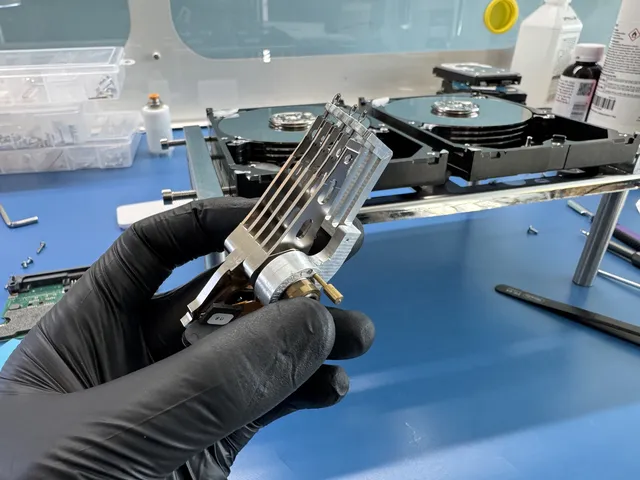
Opening a hard drive outside filtered air can put dust on platters that ruins an otherwise routine recovery. Plenty of shops advertising "ISO certified cleanroom" own a dusty back bench. At MDrepairs, head and platter work takes place in a laminar-flow work area. For help comparing labs, see our guide to choosing a recovery service.
Scams 5, 6, and 7: the lie, the borrowed reputation, the hostage
"Unrecoverable" ... unless you pay for the platinum tier
You get a sad phone call: nothing can be done. Then, a follow-up: actually, there's an "advanced forensic process" for triple the price. Recoverability isn't a pricing tier. Either the data can be read or it can't. When a second opinion is cheap and shipping is free, get one; we regularly recover drives other shops declared dead, and we tell people plainly when the reverse is true: some data truly is gone, and no tier changes that.
Reviews that belong to someone else
Scam operations clone websites of legitimate labs, embed another company's review widget, or launch a fresh Google profile every time the old one fills with one-star warnings. Check that the reviews mention the same city and company name, look for years of history rather than fifty five-star reviews in one month, and see whether the company posts real work anywhere public. We publish ours constantly; the lab you're vetting should show its work too.
Pay the "evaluation fee" or lose your drive
The final script: you decline the inflated quote and suddenly there's a $300 "diagnostic and handling fee" to get your own drive back, disassembled, parts in a baggie. This is why the fee structure has to be in writing before you ship. Our terms are simple: flat $100 diagnostic credited toward recovery, no data means no recovery charge, and declining a quote never holds your drive hostage.
The red flags at a glance
| Red flag | What it usually means |
|---|---|
| One flat price for every failure type | Bait pricing; the real quote comes after they have your drive |
| Address is a mailbox or coworking suite | Broker, not a lab; your drive ships somewhere you never agreed to |
| Quote changed after an unauthorized teardown | Ransom pricing; they know opened drives are harder to move |
| Won't explain protection from dust | Ask about a clean, filtered work area |
| "Unrecoverable" with a pricier tier attached | Recoverability being used as a sales lever |
| Brand-new profile, borrowed or burst reviews | Reputation laundering after burning the last identity |
| Return of your drive requires a fee | Hostage model; it was never about the diagnostic |
Why this industry breeds scams (knowing this protects you)
It helps to understand why data recovery attracts this behavior, because the structure of the scam follows the structure of the market. Three ingredients: the customer is under emotional duress (wedding photos, business records, a deceased parent's phone), the work is invisible (you can't watch a cleanroom job or verify a "severe damage" claim yourself), and the product is hostage-shaped (your drive is physically in their building). Add the fact that most people will only ever buy data recovery once, so repeat-customer reputation doesn't discipline bad actors the way it does in other trades.
Every protection in this article attacks one of those three ingredients: written terms neutralize duress-driven decisions, proof-of-files makes the invisible work visible, and return policies defang the hostage position. We sometimes receive drives that already made a trip through one of these operations, arriving with pry marks and missing screws, and the recoveries still succeed more often than not. But the customer paid twice and waited a month for what should have been one job.
How to protect yourself in five minutes
- Get the quote range, diagnostic fee, and no-data-no-charge policy in writing before shipping.
- Confirm the work happens in-house, in their own lab, at the address you're shipping to.
- Ask for proof of recovered files (a file listing or screen share) before payment. Legitimate labs offer this unprompted.
- Compare against realistic market ranges in our data recovery cost guide so both lowball and ransom numbers stand out.
- If a deal already went sideways, document everything; disputes over unauthorized work are winnable with a paper trail.
And if you're comparing several shops right now, our roundup of the best data recovery services shows what good actually looks like, including where we think competitors do well.
Frequently Asked Questions
How do I know if a data recovery company is legitimate?
Ask four questions: Is the work done in your own lab at this address? What's the realistic price range for my failure type, in writing? Is there a no-data-no-charge policy? Can I see proof of my files before paying? A legitimate lab answers all four easily. Evasion on any one of them is your answer.
Why do data recovery quotes vary so much between companies?
Partly because failures genuinely range from software-only fixes to cleanroom part transplants, and partly because bait pricing is rampant. The teaser number and the ransom number are both wrong; the honest bracket for your failure type usually sits in the middle and comes with an explanation of the work involved.
Can a shop keep my hard drive if I don't pay?
They can make it painful, which is the point of the hostage script: surprise "handling fees" to return your property. Prevent it by getting return terms in writing before shipping. At a reputable lab, declining the quote costs you nothing beyond any disclosed diagnostic fee.
What should I do if a company already opened my drive and raised the price?
Don't authorize more work. Request the drive back with all parts, in an anti-static bag, and get a second opinion from a lab with a clean, filtered work area. Recovery is still very possible after an amateur teardown; we see these cases regularly. Just stop the damage from continuing.
Is "no data, no charge" ever a scam itself?
The phrase is only as good as the definitions behind it. Watch for shops that count a folder of corrupted fragments as "data" to trigger the fee. Ask the sharper version: "If you don't recover the specific files I name, do I owe a recovery fee?" We define success as your files, verified by you, before payment.
How MDrepairs can help
Real cases like this come through our New Jersey lab every week. If you are dealing with one now, start here.
- Data Recovery Services Every device and failure type, recovered in our New Jersey lab. Learn more
- Hard Drive Data Recovery Mechanical, firmware and logical HDD recovery on every brand. Learn more
- Mail-In Data Recovery Free insured shipping both ways (contiguous US), anywhere in the US. Learn more
- Data Recovery Cost What recovery really costs - flat tiers, no data no charge. Learn more