Can Data Recovery Techs See Your Files? Privacy Truth
In this article
This question gets asked quietly, at the end of a phone call, almost like an afterthought. It never is. You're handing a stranger every photo, message, tax return, and late-night search you've ever saved. So let's answer it the way we'd want it answered if the drive were ours.
What a technician actually sees during recovery
Recovery has two phases, and they involve your files very differently.
Phase one is imaging. We clone your failing drive sector by sector onto healthy storage. During imaging, your data is just a stream of raw bits. Nobody is reading your documents at this stage. The tools show sector maps, error counts, and read speeds, not your wedding photos.
Phase two is verification. Once the file system is rebuilt, we have to confirm the recovery actually worked. Corrupt files can look "recovered" in a file list and still be unreadable garbage inside. So a tech spot-opens a sample: a few photos to confirm they render, a document or two to confirm it opens, a video to confirm it plays. That's the moment a human being genuinely sees a slice of your data. There's no way around it. A lab that claims zero human eyes ever touch your files either isn't verifying its work or isn't being straight with you.
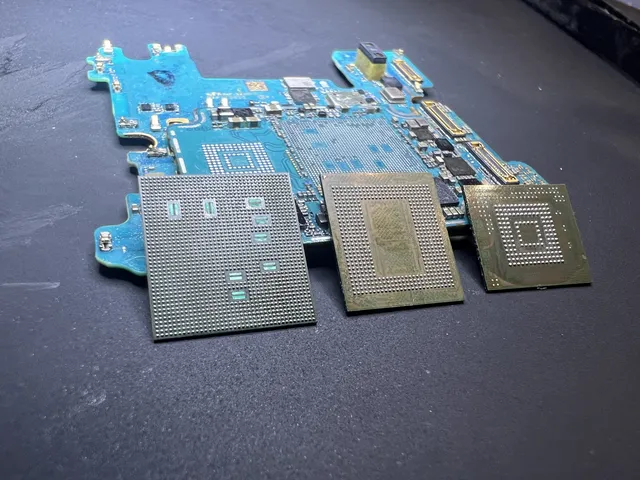
In one recorded case, a Samsung Galaxy S6 had been dead for ten years and kept in a sock drawer because it held childhood pictures. Reading the memory chip externally saved those pictures. Watch the recovery.
How professional labs handle privacy
The difference between a trustworthy lab and a sketchy one isn't whether access exists. It's the controls around that access.
- Confidentiality by default. Serious labs treat every job as confidential whether or not you ask. Many, including us, will sign an NDA for business or legal-sensitive jobs.
- Minimum-necessary viewing. Verification samples, not exploration. A tech confirming 40,000 recovered photos doesn't flip through 40,000 photos. They check a sample across folders and date ranges.
- Limited hands. In a small dedicated lab, you can literally ask who will touch the drive and get a name. At a big-box counter, your device ships to a facility you'll never see, through hands nobody names for you.
- Working copies destroyed. The recovered image lives on lab storage until you confirm you have your data, then it gets wiped. Ask any lab what their retention window is. A good one has a specific answer.
- No third-party shipping without telling you. Some storefronts quietly outsource recovery. Your files travel further than you think. Ask directly: "does my device leave your building?"
Encrypted drives: the one case where nobody sees anything
If your drive uses full-disk encryption (BitLocker, FileVault, an encrypted NAS volume) and you hold the password or key, the privacy question mostly disappears. We recover the encrypted container. Without your key, the contents are mathematically unreadable to us, to you, to anyone.
You then have a choice. You can take the encrypted image home and unlock it yourself, so no one at the lab ever sees a single file. Or you can share the key so we can verify the recovery worked before you pay for it.
The flip side: if the drive is encrypted and you've lost the key, no honest lab can help you. Anyone who says otherwise is selling something. That's not a skills gap. That's what encryption is for.
What about phones?
Phones are more personal than drives, and modern phones are encrypted by design. On an iPhone or a recent Android, the data is locked to the passcode and the security chip. When we do phone data recovery, the goal is almost always to get the phone's board working well enough to boot so the owner can unlock it with their own passcode and offload their own data. You unlock it. Not us.
That's worth repeating, because it surprises people: on a modern phone, your passcode protects you from the lab too. We can resurrect the hardware. Only your code opens the data.
Who sees your data: small lab vs. big-box chain
| Dedicated lab | Retail chain counter | |
|---|---|---|
| Who handles the drive | Named technicians, usually one or two | Store staff, then an off-site facility |
| Where data travels | Stays in one building | Shipped to a third-party lab and back |
| Who verifies files | The tech who did the recovery | Unknown to you |
| NDA available | Usually yes, on request | Rarely offered at the counter |
| Retention policy | Ask and get a specific answer | Buried in service terms |
Chain of custody is a privacy feature. The fewer buildings, shipping labels, and unnamed hands between you and your recovered files, the fewer chances for anything to go wrong. It's one of the quiet advantages of mailing your drive directly to the lab doing the work instead of dropping it at a counter that forwards it somewhere else.
The awkward part: yes, we've seen it all, and no, we don't care
Let's address what you're actually worried about. Everyone's drive has something on it they'd rather not show a stranger. Here's the honest truth from the bench: after enough recoveries, a technician's relationship to file contents becomes completely clinical. The only thing we're looking for during verification is "does this file open." A tech who treated customer data as entertainment wouldn't last in this industry, because reputation is the entire business. One privacy breach and a lab is done.
Your embarrassing folder is safe for a simpler reason too: volume. A verification pass on a big recovery samples a tiny fraction of files, chosen for format coverage, not interest. Nobody has the time to snoop, and nobody who wants to keep their job has the inclination.
How to protect your privacy when you need recovery
- Ask the three questions: Does my device leave your building? Who verifies the recovered files? How long do you keep your working copy?
- Request an NDA for business, legal, or medical data. A professional lab won't blink.
- If the drive was encrypted, decide up front whether to share the key for verification or take the encrypted image and unlock it at home.
- Don't sanitize a failing drive first. Trying to delete sensitive files off a dying drive before sending it in can destroy the very data you want back. Power it down and send it as-is.
- Skip the middlemen. Every extra business in the chain is another set of eyes and another privacy policy you never read. Go direct to whoever actually does the work at a professional recovery lab.
Frequently Asked Questions
Do data recovery companies look at your files?
They see some of them, briefly, during verification. Confirming that recovered files actually open is a required quality step, so a technician spot-checks a sample of photos and documents. Reputable labs limit viewing to that verification pass, keep the job confidential, and wipe their working copies after you've received your data.
Can I get data recovered without anyone seeing it?
Yes, if the drive is encrypted and you keep the key. The lab recovers the encrypted container and hands it back; you unlock it at home. Without encryption, some minimal viewing during verification is unavoidable at any honest lab, but you can ask that verification be limited to specific folders or file types.
Will a lab sign an NDA for a data recovery job?
A professional lab will, especially for business, legal, or medical data. If a shop acts like an NDA is a strange request, that tells you how seriously they take confidentiality generally. We sign them on request.
Is mail-in data recovery private?
Mailing directly to the lab that does the work is usually more private than a retail drop-off, not less. A store counter typically ships your device to a third-party facility anyway, adding hands and transit you never see. Direct mail-in recovery means one shipment, one building, one team.
What happens to my data after the recovery is done?
At a professional lab, the working copy stays on lab storage until you confirm your data arrived safely, then it's securely deleted. Ask for the specific retention window before you send anything in. Ours is short and we'll tell you exactly what it is on the phone.
How MDrepairs can help
Real cases like this come through our New Jersey lab every week. If you are dealing with one now, start here.