MacBook Data Recovery Torrance CA
Torrance, California is home to automotive industry professionals at Honda and Toyota nearby, aerospace engineers at Northrop Grumman, and healthcare workers at Torrance Memorial Medical Center.
- 4.6 Rating
- 2M+ Followers
- Nationwide
About this recovery service
When a MacBook fails, the data trapped on its soldered NAND flash storage cannot be accessed by any Apple Store, Genius Bar, or local repair shop. MDRepairs is a professional data recovery lab in Lincroft, NJ, specializing in MacBook Pro, MacBook Air, iMac, Mac Mini, and Mac Studio recovery. We work directly with Apple's T2 security chip, Apple Silicon processors (M1 through M4), and the proprietary NAND flash that replaces standard SSDs in every modern Mac. Torrance customers ship their MacBook to our lab with free shipping both ways (contiguous US).
Our lab performs board-level diagnosis and micro-soldering under stereo microscopes, T2 and Apple Silicon bypass, FileVault encrypted volume recovery, and CPU/NAND/EEPROM transplants for catastrophic logic board failures. Whether you are near the Del Amo Fashion Center, Honda's North American headquarters, and the Torrance Beach and Riviera Village district, your MacBook can reach our Lincroft lab in 2-3 business days via mail-in data recovery. No data, no charge - you only pay if we recover your files. Call 732-933-7717 for a free consultation.
- 2M+ Social Media Followers
- 4.6 ★ Average Rating
- $100 Flat Diagnostic Fee
- Free Shipping Both Ways
- No Data No Charge
- All 50 States Served
Common MacBook Data Loss Scenarios in Torrance
T2 Security Chip Failure
Apple Silicon Crash / Failure
FileVault Locked / Recovery Key Lost
Kernel Panic / No Boot Loop
SSD Controller Failure
Logic Board Failure
Accidental Deletion / Failed Time Machine
Physical Drop / Impact Damage
How Your MacBook Recovery Works
- 01
Free Consultation
Call 732-933-7717 or submit our secure online form. Tell us what happened - liquid spill, no power, kernel panic, FileVault lock - and a recovery engineer will walk you through your options, expected timeline, and pricing range. You generate a free prepaid UPS label on the mail-in form (contiguous US) so your MacBook or bare logic board arrives safely at our lab. - 02
$100 Board-Level Diagnostic
At our Lincroft, NJ lab, we put your MacBook under the microscope - literally. Using BGA rework stations and PC-3000 diagnostic platforms, we trace the failure to the exact component: T2 or Apple Silicon processor, NAND flash, power management IC, or liquid corrosion path. You receive a detailed diagnostic report and a firm, no-surprise quote before we touch a single solder joint. - 03
Precision Recovery
Our engineers execute the recovery using Apple-specific board-level techniques refined across hundreds of MacBook cases. Depending on the failure, that means repairing the logic board to restore native data access, bypassing T2/Apple Silicon encryption at the hardware level, or performing a CPU/NAND/EEPROM transplant to a known-good donor board when the original board is beyond repair. Every step is performed under magnification with medical-grade precision. - 04
Verification & Return
Every recovered file is verified for integrity - documents open, photos render, videos play without artifacts. Your data is transferred to a new external drive and shipped back with free shipping (contiguous US). No data, no charge: if we can't recover your target files, you pay only the $100 diagnostic fee.
Free shipping (contiguous US) from Torrance CA - $100 diagnostic - no data, no charge.
Affirm financing, if eligibleMacBook Data Recovery Pricing - Torrance CA
MacBook data recovery pricing for Torrance customers depends on the failure type, Mac model, and complexity of the storage architecture. Every case starts with a $100 board-level diagnostic at our Lincroft, NJ lab. You receive a detailed diagnostic report and firm quote before any recovery work begins. Free shipping both ways (contiguous US) from Torrance - no hidden costs. No data recovered means no charge beyond the diagnostic fee.
Standard
$1,500
- APFS file system repair
- Deleted file recovery
- macOS corruption repair
- Time Machine data extraction
- Free return shipping
Advanced
$1,500
- T2 / Apple Silicon bypass
- Board-level component repair
- FileVault encrypted recovery
- Liquid damage board restoration
- Free return shipping
Critical
$3,500+
- CPU / NAND / EEPROM transplant
- Donor motherboard sourcing
- Secure Enclave key preservation
- Full encrypted data reconstruction
- Free return shipping
Apple Mac Models We Recover for Torrance Customers
MDRepairs recovers data from every Mac with soldered or integrated storage - MacBook Pro, MacBook Air, iMac, Mac Mini, Mac Studio, and Mac Pro. Whether your Mac was purchased in Torrance or anywhere in California, our Lincroft, NJ lab handles every model and every generation of Apple Silicon and Intel processors. Below is our complete list of supported models.
- MacBook Pro 13" (2015) - Intel, Removable PCIe SSD
- MacBook Pro 15" (2015) - Intel, Removable PCIe SSD
- MacBook Air 13" (2013-2017) - Intel, Removable PCIe SSD
- MacBook Pro 13" (2016) - Intel, Touch Bar, Soldered SSD
- MacBook Pro 13" (2017) - Intel, Touch Bar, Soldered SSD
- MacBook Pro 15" (2016) - Intel, Touch Bar, Soldered SSD
- MacBook Pro 15" (2017) - Intel, Touch Bar, Soldered SSD
- MacBook 12" (2015) - Intel Core M, Soldered SSD
- MacBook 12" (2016) - Intel Core m3/m5/m7, Soldered SSD
- MacBook 12" (2017) - Intel Core m3/i5/i7, Soldered SSD
- MacBook Pro 13" (2018) - Intel, T2 Chip, Soldered SSD
- MacBook Pro 13" (2019) - Intel, T2 Chip, Soldered SSD
- MacBook Pro 13" (2020) - Intel, T2 Chip, Soldered SSD
- MacBook Pro 15" (2018) - Intel, T2 Chip, Soldered SSD
- MacBook Pro 15" (2019) - Intel, T2 Chip, Soldered SSD
- MacBook Pro 16" (2019) - Intel, T2 Chip, Soldered SSD
- MacBook Air 13" (2018) - Intel Retina, T2 Chip, Soldered SSD
- MacBook Air 13" (2019) - Intel Retina, T2 Chip, Soldered SSD
- MacBook Air 13" (2020) - Intel, T2 Chip, Soldered SSD
- iMac 27" (2019) - Intel, T2 Chip, SSD / Fusion Drive
- iMac 27" (2020) - Intel, T2 Chip, SSD / Fusion Drive
- Mac Mini (2018) - Intel, T2 Chip, Soldered SSD
- MacBook Pro 13" (2020) - Apple M1, Soldered SSD
- MacBook Pro 13" (2022) - Apple M2, Soldered SSD
- MacBook Pro 14" (2021) - Apple M1 Pro / M1 Max, Soldered SSD
- MacBook Pro 14" (2023) - Apple M2 Pro / M2 Max, Soldered SSD
- MacBook Pro 14" (2023) - Apple M3, Soldered SSD
- MacBook Pro 14" (2023) - Apple M3 Pro / M3 Max, Soldered SSD
- MacBook Pro 14" (2024) - Apple M4, Soldered SSD
- MacBook Pro 14" (2024) - Apple M4 Pro / M4 Max, Soldered SSD
- MacBook Pro 16" (2021) - Apple M1 Pro / M1 Max, Soldered SSD
- MacBook Pro 16" (2023) - Apple M2 Pro / M2 Max, Soldered SSD
- MacBook Pro 16" (2023) - Apple M3 Pro / M3 Max, Soldered SSD
- MacBook Pro 16" (2024) - Apple M4 Pro / M4 Max, Soldered SSD
- MacBook Air 13" (2020) - Apple M1, Soldered SSD
- MacBook Air 13" (2022) - Apple M2, Soldered SSD
- MacBook Air 13" (2024) - Apple M3, Soldered SSD
- MacBook Air 15" (2023) - Apple M2, Soldered SSD
- MacBook Air 15" (2024) - Apple M3, Soldered SSD
- iMac 24" (2021) - Apple M1, Soldered SSD
- iMac 24" (2023) - Apple M3, Soldered SSD
- iMac 24" (2024) - Apple M4, Soldered SSD
- Mac Mini (2020) - Apple M1, Soldered SSD
- Mac Mini (2023) - Apple M2 / M2 Pro, Soldered SSD
- Mac Mini (2024) - Apple M4 / M4 Pro, Soldered SSD
- Mac Studio (2022) - Apple M1 Max / M1 Ultra, Soldered SSD
- Mac Studio (2023) - Apple M2 Max / M2 Ultra, Soldered SSD
- Mac Studio (2024) - Apple M4 Max, Soldered SSD
- Mac Pro (2023) - Apple M2 Ultra, Soldered SSD
- iMac 21.5" (2017) - Intel, SSD / Fusion Drive
- iMac 21.5" (2019) - Intel, SSD / Fusion Drive
- iMac 27" (2017) - Intel, SSD / Fusion Drive
- Mac Pro (2019) - Intel Xeon W, Modular SSD
MacBook Storage Architecture: Why Torrance Mac Users Need Specialized Recovery

Understanding why MacBook data recovery requires specialized expertise starts with Apple's storage architecture evolution - and why Torrance Mac users cannot rely on local repair shops or the Apple Store for data recovery. Before 2016, MacBooks used removable PCIe SSD modules. If your logic board died, a technician could unscrew the SSD, plug it into another Mac or an adapter, and copy your files. That era is over.
Starting with the 2016 MacBook Pro, Apple soldered NAND flash storage chips directly onto the logic board. There is no removable drive, no SSD module, and no way to access your data by simply swapping components. The storage is physically bonded to the same circuit board as the processor, memory, and every other component using hundreds of microscopic BGA (Ball Grid Array) solder connections. For Torrance professionals - automotive industry professionals at Honda and Toyota nearby, aerospace engineers at Northrop Grumman, and healthcare workers at Torrance Memorial Medical Center - this means that when a MacBook fails, your data is trapped on chips that cannot be removed without professional BGA rework equipment.
Continue reading 3 more paragraphs
Even if someone could desolder the NAND packages, reading the raw data requires Apple-specific tools. Apple uses proprietary page geometry, ECC (Error Correcting Code) algorithms, and data scrambling that standard NAND readers cannot interpret. On top of that, every Mac since 2018 encrypts all storage through either the T2 security chip (Intel models) or the Apple Silicon Secure Enclave (M1 through M4). The encryption keys never leave the processor die, making chip-off extraction without the original CPU impossible for encrypted volumes.
At MDRepairs, our Lincroft, NJ lab handles MacBook data recovery for customers across California, including Torrance. We maintain the specialized BGA rework stations, Apple-specific NAND reading tools, and PC-3000 diagnostic platforms required to work with soldered Apple storage. Whether you have a 2016 MacBook Pro with a failed logic board or a 2024 MacBook Air M3 that won't power on, our lab has the tools and expertise that no Apple Store or general repair shop in Torrance can match. We provide free shipping both ways (contiguous US), so your MacBook arrives safely at our lab from anywhere in California.
The critical point for Torrance customers: do not let anyone attempt a DIY fix or open your MacBook to "try something" before sending it to a professional lab. Well-meaning but unqualified repair attempts - especially on liquid-damaged boards - frequently cause additional damage that makes recovery harder or impossible. Contact our lab first at 732-933-7717 for a free consultation before taking any action.
T2 Security Chip Recovery for Torrance MacBook Owners

The Apple T2 security chip, introduced in 2018, fundamentally changed MacBook data recovery - and Torrance Mac users with 2018-2020 Intel MacBooks need to understand exactly what that chip does and why it matters when data recovery becomes necessary. The T2 is not just a security feature. It serves as the SSD controller, hardware encryption engine, audio processor, and system management controller all in one. Every byte written to the NAND flash passes through the T2 chip and is encrypted with AES-256 hardware encryption using keys stored exclusively inside the T2 itself.
When the T2 chip fails - due to liquid damage, power surge, firmware corruption, or component-level board failure - your Mac sees no internal storage whatsoever. Disk Utility shows nothing. Recovery Mode shows nothing. Target Disk Mode cannot find a volume. The NAND chips still hold all your data in encrypted form, but without a functioning T2 to decrypt and relay that data, it is completely inaccessible. No software, no boot USB, and no standard repair tool can bypass this. The Apple Store in California will tell you the machine needs a logic board replacement - which erases all data.
Continue reading 3 more paragraphs
Our Lincroft, NJ lab recovers data from T2-equipped MacBooks using two primary approaches. First, we attempt board-level repair to restore T2 function. Our technicians trace the failure using board schematics and thermal imaging to identify the specific component preventing T2 initialization - often a corroded power rail, failed capacitor, or damaged trace between the T2 and NAND packages. If we can repair the board and get the T2 communicating with the NAND again, your data is accessible through normal channels.
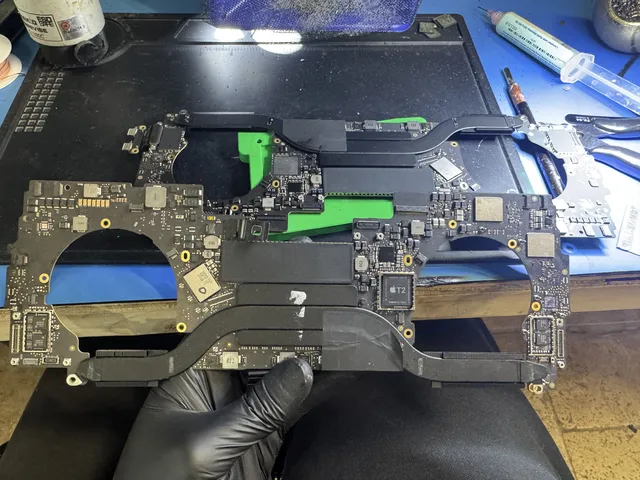
When board-level repair cannot restore T2 function, we perform a CPU/NAND/EEPROM swap. This involves carefully desoldering the T2 chip (which on Intel Macs is separate from the CPU), the NAND flash packages, and supporting EEPROMs from your failed logic board, then transplanting them onto a known-good donor board. Because the encryption keys reside in the T2 and the encrypted data lives on the NAND, both must be moved together to maintain the cryptographic relationship. For Torrance customers, we provide free shipping (contiguous US) to our Lincroft lab - your MacBook can be in transit overnight from anywhere in California.
T2 MacBook models affected include the 2018-2020 MacBook Pro 13-inch, 15-inch, and 16-inch; the 2018-2020 MacBook Air; and the 2018 Mac Mini. If you are in Torrance and your Intel Mac with a T2 chip has stopped recognizing its internal storage, do not attempt to reinstall macOS or reset the SMC repeatedly - contact our lab at 732-933-7717 for a diagnostic assessment before taking any further action.
Apple Silicon (M1/M2/M3/M4) Data Recovery for Torrance Customers

Apple's transition to its own processors - M1, M2, M3, and M4 - created the most challenging data recovery scenario in consumer computing history, and Torrance Mac users need to understand why. Unlike Intel Macs with the separate T2 chip, Apple Silicon integrates the SSD controller, Secure Enclave (encryption engine), Neural Engine, and all processing cores onto a single system-on-chip (SoC). The NAND flash storage is still soldered to the logic board separately, but all communication with that storage - including hardware encryption and decryption - runs through the Apple Silicon processor exclusively.
When an M1, M2, M3, or M4 processor fails, there is no secondary path to the NAND. The data is encrypted with keys that exist only in the Secure Enclave portion of the processor die. Chip-off NAND extraction - desoldering the NAND and reading it with external tools - produces encrypted data that cannot be decrypted without the original processor. This is by design. Apple built a system where the CPU, NAND, and EEPROMs form a cryptographically bound trio, and separating any component from the group makes the data unreadable.
Continue reading 3 more paragraphs
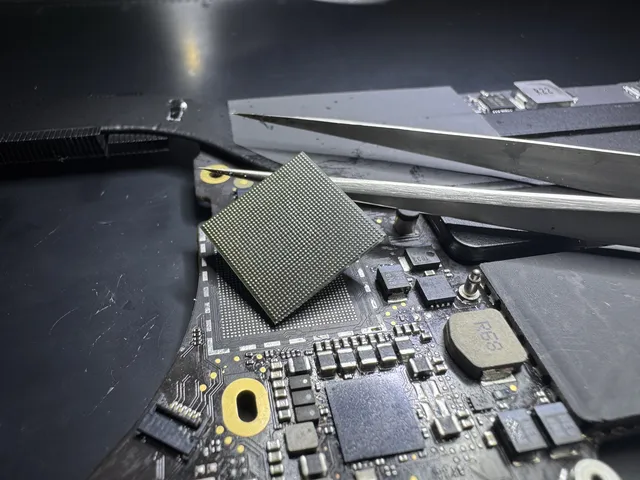
Our recovery approach for catastrophic Apple Silicon failures is the CPU/NAND/EEPROM swap. We desolder the original Apple Silicon processor (which contains the Secure Enclave and encryption keys), the NAND flash packages (which contain the encrypted data), and the board EEPROMs (which contain configuration data the system needs to initialize) from the failed logic board. All three component groups are then transplanted onto a known-good donor logic board of the same model. Because the original CPU retains its Secure Enclave keys and the original NAND retains the data encrypted by those keys, the donor board boots with full access to the encrypted volume.
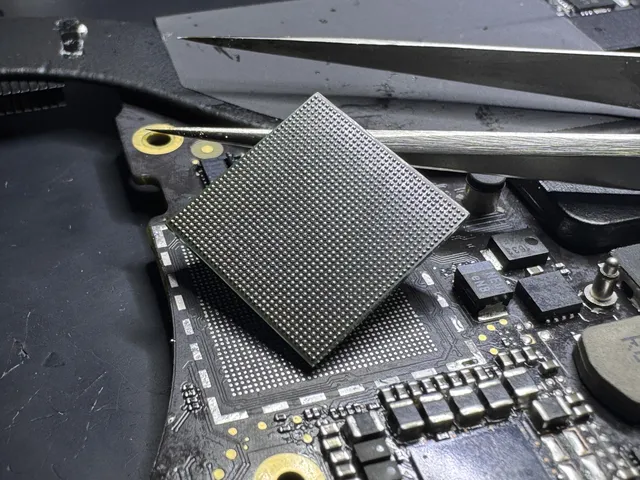
This procedure demands extreme precision. Apple Silicon BGA packages have hundreds of solder connections spaced fractions of a millimeter apart. Desoldering and reballing these chips without damaging the silicon requires controlled thermal profiles specific to each chip package. Our Lincroft, NJ lab uses programmable BGA rework stations with Apple-specific profiles refined across hundreds of MacBook cases. For Torrance customers, we provide free shipping (contiguous US) - your MacBook travels from California to our New Jersey lab and back at no cost to you.
If your Apple Silicon MacBook in Torrance shows no signs of life, displays a dead screen, or enters DFU mode without recovery options, the processor may have failed but the NAND is likely intact. Contact us at 732-933-7717 before attempting any resets or reinstalls. The most important step is to stop using the machine and get it to a lab equipped for Apple Silicon recovery - which, in the current landscape, means a specialist lab like MDRepairs, not an Apple Store or local shop in Torrance.
MacBook Pro Data Recovery in Torrance: Every Model Covered

The MacBook Pro is the most common Apple laptop we recover data from at our Lincroft, NJ lab, and Torrance customers send us every model from the 2015 Retina through the latest 2024 M4 series. Each generation presents unique recovery challenges based on its storage architecture, security chip, and processor type. Understanding which MacBook Pro you have determines the recovery approach our technicians will use.
The 2015 MacBook Pro 13-inch and 15-inch models used removable PCIe SSDs - the last generation to do so. If you have one of these in Torrance, data recovery is comparatively straightforward because the SSD module can be removed and read in another compatible system. Starting with the 2016 MacBook Pro, Apple soldered the NAND flash directly to the logic board and introduced the Touch Bar models. These 2016-2017 MacBook Pro models have soldered NAND but no T2 chip, making them recoverable through board-level repair or NAND chip-off extraction without encryption complications from a security coprocessor.
Continue reading 3 more paragraphs
The 2018-2020 Intel MacBook Pro models introduced the T2 security chip, which encrypts all storage through hardware. These are some of the most complex recoveries we handle. The T2 serves as both SSD controller and encryption engine, so any failure that disrupts T2 function cuts off all data access. The MacBook Pro 16-inch (2019) was particularly popular among automotive industry professionals at Honda and Toyota nearby, aerospace engineers at Northrop Grumman, and healthcare workers at Torrance Memorial Medical Center, and we see significant volume from Torrance on this model specifically.
The 2020 MacBook Pro 13-inch was the first with an M1 option, and subsequent models - the 14-inch and 16-inch in M1 Pro/Max (2021), M2 Pro/Max (2023), M3/M3 Pro/Max (2023), and M4/M4 Pro/Max (2024) - all use Apple Silicon with integrated storage controllers and Secure Enclave encryption. Recovery requires the CPU/NAND/EEPROM swap procedure described elsewhere on this page. These high-end MacBook Pro models are workhorses for professionals in Torrance - automotive industry professionals at Honda and Toyota nearby, aerospace engineers at Northrop Grumman, and healthcare workers at Torrance Memorial Medical Center - and the data on them is often irreplaceable.
Regardless of which MacBook Pro you own in Torrance, our recovery process starts the same way: call 732-933-7717 or submit our online form, and you generate a free prepaid UPS label on the mail-in form (contiguous US). Your MacBook Pro arrives at our Lincroft lab, undergoes a $100 board-level diagnostic, and you receive a detailed report and firm quote before we proceed. No data recovered means no charge beyond the diagnostic fee. We handle every MacBook Pro model ever made - contact us from anywhere in California.
MacBook Air Data Recovery for Torrance Residents

The MacBook Air is Apple's most popular laptop by volume, and we recover data from MacBook Air models sent to our lab from Torrance and across California regularly. Because the Air is the default choice for students, writers, remote workers, and everyday users - exactly the people least likely to maintain rigorous backups - we see a disproportionate number of Air recoveries relative to its professional sibling, the MacBook Pro.
Modern MacBook Air models present the same fundamental recovery challenge as the Pro: soldered NAND flash storage that cannot be removed and read conventionally. The 2018 and 2019 MacBook Air Retina models use Intel processors with the T2 security chip, meaning all storage is hardware-encrypted through the T2. The 2020 MacBook Air came in both Intel T2 and M1 Apple Silicon variants. The 2022 Air introduced M2, and the 2024 models use M3. Every one of these has soldered, encrypted storage that requires board-level expertise to recover.
Continue reading 3 more paragraphs
What makes MacBook Air recovery particularly urgent for Torrance customers is the user profile. Students at El Camino College rely on their Air for coursework, research papers, and project files that may not exist anywhere else. Remote workers use their Air as their sole machine, with years of documents, client files, and creative work stored locally. Many Air users in Torrance chose the base 256GB configuration, which means they ran out of cloud storage quickly and kept critical files only on the internal drive.
The MacBook Air is also more susceptible to liquid damage than the MacBook Pro due to its thinner chassis and less robust thermal management. A coffee spill on a MacBook Air can reach the logic board in seconds, and the thin form factor means liquid spreads across more of the board surface area faster. For Torrance residents who experience a liquid spill on their Air, the critical step is to power off immediately, do not attempt to turn it back on, and contact our lab at 732-933-7717. Powering on a liquid-damaged Air accelerates corrosion and can turn a recoverable case into a permanent data loss.
We recover data from every MacBook Air model at our Lincroft, NJ lab. Whether your Air suffered liquid damage, won't power on, shows the flashing question mark folder, or experienced a kernel panic loop, we have the board-level tools and Apple-specific expertise to access your data. Free shipping (contiguous US) from Torrance to our lab and back - contact us to get started.
iMac, Mac Mini, and Mac Studio Recovery in Torrance

While MacBook laptops dominate our recovery volume, Torrance customers also send us iMacs, Mac Minis, and Mac Studios that have suffered data loss. These desktop Macs share the same fundamental storage architecture as MacBooks - soldered NAND flash with T2 or Apple Silicon encryption - but their different form factors and use cases create unique recovery scenarios that Torrance professionals should understand.
The iMac transitioned to soldered storage with the 2021 M1 model (24-inch). Earlier Intel iMacs (2017-2020) used either standard SATA SSDs, Apple proprietary blade SSDs, or Fusion Drives (a combination of SSD and spinning hard drive). If your iMac in Torrance has a Fusion Drive that failed, recovery depends on which component died - the SSD cache or the hard drive. Our lab handles both. The 2021-2024 M1/M3/M4 iMacs have soldered NAND with Apple Silicon encryption, requiring the same CPU/NAND/EEPROM swap procedure as MacBooks for catastrophic processor failures.
Continue reading 3 more paragraphs
Mac Minis are popular with automotive industry professionals at Honda and Toyota nearby, aerospace engineers at Northrop Grumman, and healthcare workers at Torrance Memorial Medical Center as compact workstations, media servers, and development machines. The 2018 Mac Mini introduced the T2 chip with soldered encrypted storage. The 2020 M1, 2023 M2/M2 Pro, and 2024 M4/M4 Pro Mac Minis all use Apple Silicon with integrated encryption. Mac Mini failures often involve power surge damage - Torrance residents connected to older power grids or using inadequate surge protection can experience voltage spikes that kill the logic board while leaving NAND intact.
The Mac Studio, Apple's high-performance compact desktop, launched in 2022 with M1 Max and M1 Ultra options, followed by M2 Max/Ultra in 2023 and M4 Max in 2024. These are professional workstations used by video editors, 3D artists, and developers - many of whom have tens of thousands of dollars worth of project files on their soldered internal storage. Mac Studio recovery follows the same Apple Silicon procedures as MacBook recovery, with the added complexity of Ultra chip variants that use two interconnected dies.
For Torrance customers with desktop Mac data loss: do not attempt to open the chassis and access components yourself. iMacs require specialized display removal tools, and both Mac Mini and Mac Studio have tightly integrated logic boards that can be damaged by improper handling. Contact our Lincroft, NJ lab at 732-933-7717 - we provide free shipping (contiguous US) for desktop Macs as well. Your iMac, Mac Mini, or Mac Studio can be packed and shipped to our lab safely with our prepaid labels from anywhere in California.
FileVault Encryption and MacBook Data Recovery in Torrance

FileVault full-disk encryption on macOS adds a critical layer of complexity to MacBook data recovery, and Torrance Mac users with FileVault enabled need to understand how this technology interacts with hardware failures before data loss occurs. FileVault is enabled by default on new Macs and uses XTS-AES-128 encryption tied directly to the hardware security processor - the T2 chip on 2018-2020 Intel Macs or the Secure Enclave within Apple Silicon on M1-M4 Macs.
Here is the key point for Torrance customers: FileVault encryption keys never leave the security processor. They are generated on the chip, stored on the chip, and used on the chip. When you type your macOS password or use Touch ID, the security processor validates your credentials and uses its internally stored keys to decrypt data on the fly as it is read from the NAND. Your password does not decrypt the data directly - it unlocks the security processor's permission to use the keys it already holds.
Continue reading 3 more paragraphs
This means that if the T2 chip or Apple Silicon processor fails, the encryption keys are trapped inside the dead processor. The NAND still contains all your encrypted data, but without those keys, it is mathematically impossible to decrypt. This is why our CPU/NAND/EEPROM swap procedure exists - by transplanting the original processor (with its Secure Enclave and keys) to a working donor board, we restore the cryptographic relationship and unlock the encrypted volume.
For Torrance Mac users who have lost their FileVault recovery key: if your Mac still powers on and you can reach the login screen, we can often recover data through board-level techniques that restore the authentication pathway without needing the recovery key. The recovery key is a secondary decryption path - the primary path runs through the security processor, and if that hardware is intact, we can work with it. However, if you have completely forgotten your password AND lost the recovery key AND the security processor has failed, recovery becomes significantly more complex.
Our recommendation for Torrance professionals, students at El Camino College, and anyone with critical data on a Mac: store your FileVault recovery key in a secure location separate from your Mac. Apple offers to store it in your iCloud account, or you can write it down and keep it in a safe. If you experience a Mac failure with FileVault enabled, contact MDRepairs at 732-933-7717 immediately. Do not attempt to reinstall macOS, erase the disk, or reset the SMC - each of these actions can compromise the encryption state and make recovery harder. Time and inaction are your best allies until your Mac reaches our lab.
Liquid Damage MacBook Recovery for Torrance Mac Users

Liquid damage is the leading cause of MacBook data loss we see at our Lincroft, NJ lab, and Torrance Mac users are not immune. Coffee spills during morning work sessions, water bottle leaks inside laptop bags, rain exposure during commutes, and even humidity-related condensation in California's climate can all introduce liquid to a MacBook's logic board with devastating consequences. What makes liquid damage particularly insidious is that the damage is progressive - a MacBook that seems fine after a spill can die days or weeks later as corrosion silently spreads across the board.
When liquid reaches a MacBook logic board, it creates electrical shorts between components and initiates chemical corrosion on copper traces, solder joints, and BGA pad connections. The corrosion process does not stop when the liquid evaporates. Mineral deposits from tap water, sugars from coffee and soda, and salts from any liquid source continue corroding metal surfaces in the presence of ambient humidity. Every hour a liquid-damaged MacBook sits without professional cleaning, the corrosion spreads further.
Continue reading 3 more paragraphs
The rice myth needs to die. Putting your MacBook in rice does absolutely nothing to address internal corrosion. Rice cannot absorb liquid from inside a sealed chassis, it cannot remove mineral deposits from circuit board traces, and rice dust can actually introduce additional contamination into ports and vents. If you spill liquid on your MacBook in Torrance, here is what to do: power off immediately (hold the power button for 10 seconds), do not attempt to turn it back on, flip it upside down to let excess liquid drain out of the keyboard, and contact our lab at 732-933-7717.
Our liquid damage recovery process begins with a complete ultrasonic cleaning of the logic board using specialized cleaning solutions that dissolve corrosion without damaging components. After cleaning, our technicians inspect the entire board under a stereo microscope at up to 50x magnification, identifying every corroded trace, damaged solder joint, and failed component. We then micro-solder repairs - replacing corroded resistors, capacitors, and ICs; rebuilding damaged traces with copper wire jumpers; and restoring power delivery to the T2 chip or Apple Silicon processor.
For Torrance customers: the sooner a liquid-damaged MacBook reaches our lab, the better the chances of full recovery. Corrosion damage that is limited to a few components after 24 hours can spread to dozens of connections after a week. We offer expedited shipping options and prioritize liquid damage cases when possible because timing directly impacts outcomes. Do not waste days trying local repair shops in Torrance that lack the ultrasonic cleaning, micro-soldering, and board-level diagnostic capabilities this work requires. Contact MDRepairs immediately.
Logic Board Failure and Data Access for Torrance Mac Users

A dead MacBook logic board does not mean dead data - and this is the single most important thing Torrance Mac users need to understand when their MacBook stops working. The logic board (motherboard) is the central circuit board that connects every component in your Mac: processor, memory, storage, display, keyboard, trackpad, and power management. When the logic board fails, the Mac appears completely dead or malfunctions severely. But the NAND flash chips holding your data are almost always physically intact.
Logic board failures have many causes. Power surges from faulty chargers or unstable power outlets - a real concern for Torrance residents in older buildings - can blow MOSFETs, voltage regulators, and power management ICs. Thermal stress from years of heavy use causes solder joint fatigue, especially under large BGA components like the CPU and GPU. Manufacturing defects in specific capacitors or resistors can cause failures years after purchase. And physical impact from drops or pressure can crack PCB traces and fracture solder connections that are invisible to the naked eye.
Continue reading 3 more paragraphs
The Apple Store response to a logic board failure is a complete board replacement - which means your data is gone, because the NAND storage is soldered to the old board and the encryption keys on the T2 or Apple Silicon processor go with it. Apple does not offer data recovery, and they will not return your old logic board. This is why Torrance Mac users must contact a data recovery lab before visiting the Apple Store if data preservation is the priority.
Our Lincroft lab approaches logic board failures methodically. Using board schematics (which we maintain for every MacBook model), thermal imaging cameras, and multi-meter probing, we trace the failure to the specific component or circuit that died. Many logic board failures are caused by a single component - a blown MOSFET, a shorted capacitor, a failed power IC - and repairing that single component restores full board function and full data access. This board-level repair approach is faster, less invasive, and less expensive than a CPU/NAND/EEPROM swap.
When the logic board damage is too extensive for component-level repair - multiple failed power rails, catastrophic liquid corrosion affecting dozens of components, or physical board fractures - we proceed with the CPU/NAND/EEPROM swap to a donor motherboard. For Torrance customers, we always attempt board-level repair first because it preserves the original hardware relationship and carries a lower cost. Contact us at 732-933-7717 or submit our online form to start the process with a free consultation and free shipping (contiguous US) from anywhere in California.
NAND Chip-Off and CPU/NAND/EEPROM Swap Recovery in Torrance

NAND chip-off extraction and CPU/NAND/EEPROM swap represent the most advanced data recovery techniques available for MacBooks, and they are critical capabilities for Torrance Mac users facing catastrophic hardware failures. These procedures involve physically desoldering components from the logic board using precision BGA rework equipment and either reading them directly (chip-off) or transplanting them to functional hardware (CPU/NAND/EEPROM swap).
NAND chip-off - desoldering the NAND flash packages and reading their raw contents with specialized NAND readers - is a valid recovery method only for pre-2018 MacBooks that lack T2 or Apple Silicon encryption. On these older Macs (2016-2017 MacBook Pro, 2015-2017 MacBook Air with removable SSDs excluded), the NAND contains unencrypted or software-encrypted data that can be reassembled using Apple-specific NAND reconstruction tools. Our lab uses controlled-temperature BGA desoldering with profiles specific to each NAND package type, then reads the raw pages and reconstructs the APFS file system from the extracted data.
Continue reading 3 more paragraphs
For 2018 and newer MacBooks with hardware encryption (T2 or Apple Silicon), chip-off extraction alone produces encrypted data that cannot be decrypted. This is where the CPU/NAND/EEPROM swap becomes the only viable recovery path for catastrophic board failures. The procedure works because Apple's encryption system creates a cryptographic trio: the CPU (containing the Secure Enclave with encryption keys), the NAND (containing the encrypted data), and the EEPROMs (containing board configuration data the system needs to boot). All three must be present together on a functional board for data access.
The swap procedure requires extraordinary precision. Apple's M-series processors and T2 chips use fine-pitch BGA packages with hundreds of solder connections. Desoldering these chips without damaging the silicon or the pads requires programmable rework stations with precise thermal profiles - too much heat cracks the silicon die, too little fails to release the solder connections. Our Lincroft lab has refined these thermal profiles across hundreds of MacBook recovery cases, and we use X-ray inspection to verify solder joint integrity after each transplant.
For Torrance customers: if another shop has told you your MacBook is unrecoverable due to a dead logic board, contact our lab for a second opinion. We regularly recover data from Macs that other companies - including national data recovery chains - have declared hopeless. The CPU/NAND/EEPROM swap is not a procedure most labs can perform, because it requires specific donor board sourcing, Apple-specific BGA rework profiles, and deep familiarity with Apple's encryption architecture. Call 732-933-7717 for a free consultation, and we will assess whether your MacBook's data is recoverable.
Mac vs. PC Data Recovery - What Torrance Customers Should Know
MacBook data recovery and PC laptop data recovery are fundamentally different disciplines, and Torrance Mac users should understand these differences before choosing a recovery provider. The core distinction comes down to storage architecture: most Windows PCs use standard NVMe or SATA SSDs that can be removed and plugged into another system, while every MacBook since 2016 uses proprietary soldered NAND flash that cannot be removed or read through standard interfaces.
On a typical Windows laptop, if the motherboard dies, a technician removes the M.2 NVMe SSD, plugs it into a USB enclosure or another PC, and copies the files. The entire process takes 15 minutes and requires no specialized equipment. If the SSD itself has failed, PC-3000 and similar professional platforms can communicate with standard NVMe controllers to extract data at the firmware level. The drive standards are open, well-documented, and supported by every data recovery lab in the industry.
Continue reading 3 more paragraphs
MacBook recovery shares none of these conveniences. The NAND is soldered, the controller is integrated into a proprietary security chip, the data is hardware-encrypted with keys stored in a Secure Enclave, and the file system (APFS) uses Apple-specific metadata structures. A data recovery lab that handles MacBooks must have BGA rework capability, Apple board schematics, T2 and Apple Silicon diagnostic tools, NAND reading equipment compatible with Apple's proprietary page geometry, and donor boards for CPU/NAND/EEPROM swaps. Most PC-focused recovery labs have none of these.
For Torrance customers comparing data recovery quotes: be wary of any lab that quotes the same price for MacBook recovery as they do for standard PC SSD recovery. If they are pricing them the same, they likely plan to attempt only software-level recovery - which works for simple file system corruption but fails completely when the hardware is dead, the T2 has failed, or the Apple Silicon processor is non-functional. Board-level MacBook recovery requires different skills, different tools, and different procedures than PC recovery.
Our Lincroft, NJ lab specializes in both Mac and PC data recovery, but we maintain completely separate toolsets and workflows for each platform. Our MacBook recovery capability includes BGA rework stations with Apple-specific thermal profiles, a library of donor MacBook logic boards for CPU/NAND/EEPROM swaps, PC-3000 with Apple SSD modules, and deep expertise in APFS file system reconstruction. When you contact us from Torrance at 732-933-7717, we assess your specific Mac model and failure type and provide a quote that reflects the actual work required - not a generic price that assumes a simple software fix.
Preventing MacBook Data Loss in Torrance: Time Machine, iCloud, and Backup Strategies
The best MacBook data recovery is the one you never need, and Torrance Mac users can take concrete steps today to protect their data against hardware failure, liquid damage, theft, and accidental deletion. While no backup strategy is perfect, implementing even one of these recommendations dramatically reduces your risk of catastrophic data loss.
Time Machine is Apple's built-in backup solution, and it remains the most comprehensive local backup option for Mac users. An external USB-C or Thunderbolt SSD connected to your MacBook and configured for Time Machine creates automatic hourly backups of your entire system - every file, every application, every setting. For Torrance professionals who work from a desk regularly, keeping a Time Machine drive connected during work hours provides near-real-time protection. Time Machine drives are affordable - a 2TB external SSD costs under $100 and provides years of incremental backup history for most users.
Continue reading 4 more paragraphs
iCloud Drive offers cloud-based backup and file synchronization, but Torrance Mac users need to understand its limitations. iCloud does not back up your entire Mac - it syncs specific folders (Desktop, Documents) and application data, but it does not protect locally stored files outside those folders, application configurations, email databases, or system files. If you rely on iCloud as your only backup and your MacBook dies, you will recover your Documents folder but lose everything else. iCloud should supplement Time Machine, not replace it.
For Torrance professionals with mission-critical data - automotive industry professionals at Honda and Toyota nearby, aerospace engineers at Northrop Grumman, and healthcare workers at Torrance Memorial Medical Center - we recommend the 3-2-1 backup strategy: three copies of your data, on two different types of media, with one copy stored off-site. Example: your MacBook's internal storage (copy 1), a Time Machine external drive at your desk (copy 2, different media), and a cloud backup service like Backblaze, Carbonite, or iCloud (copy 3, off-site). This strategy protects against hardware failure, theft, fire, and natural disaster simultaneously.
Additional preventive measures for Torrance Mac users: always use a high-quality surge protector or UPS (uninterruptible power supply) when working from a desk - power surges are a leading cause of logic board failure. Never use third-party USB-C chargers from unknown manufacturers - cheaply made chargers can deliver voltage spikes that destroy the power management circuitry. Keep liquids away from your MacBook or invest in a keyboard cover if you must have your coffee nearby. And if you notice any unusual behavior - random shutdowns, kernel panics, clicking sounds, or sluggish performance - back up your data immediately before the problem worsens. These symptoms often precede complete failure.
If prevention fails and you need MacBook data recovery in Torrance, contact MDRepairs at 732-933-7717. We provide free shipping (contiguous US) from anywhere in California, a $100 board-level diagnostic, and a no-data-no-charge policy on all recoveries.
Apple APFS File System and Recovery Challenges for Torrance Mac Users
Apple's APFS (Apple File System) replaced the decades-old HFS+ file system starting with macOS High Sierra in 2017, and every Mac sold since then - including every MacBook used by Torrance residents today - runs APFS as its native file system. Understanding APFS is relevant to data recovery because the file system's design directly impacts how data can and cannot be recovered when things go wrong.
APFS was designed from the ground up for solid-state storage and includes features that benefit daily use but complicate recovery: space sharing across multiple volumes on a single container, native full-disk encryption integration, copy-on-write metadata for crash protection, snapshot support for Time Machine, and TRIM integration for SSD performance optimization. Each of these features interacts with the recovery process in specific ways that Torrance Mac users should understand.
Continue reading 4 more paragraphs
The copy-on-write architecture means that APFS never overwrites existing metadata in place - instead, it writes new metadata to a different location and then updates pointers to reference the new copy. This provides excellent crash protection during normal operation (if the system crashes mid-write, the old metadata is still intact), but it also means that file system corruption can create complex chains of orphaned metadata blocks that require specialized APFS parsing tools to untangle. Standard file recovery software designed for HFS+ or Windows NTFS cannot properly parse APFS structures.
TRIM is particularly relevant for data recovery. When you delete a file on an APFS volume with TRIM enabled (which is every modern Mac), the file system notifies the SSD controller that those storage blocks are no longer needed. The controller then physically erases those NAND pages during garbage collection to maintain write performance. Once TRIM completes, the deleted data is gone at the hardware level - no recovery tool, no matter how advanced, can retrieve data from physically erased NAND cells. This is why we tell Torrance customers: if you accidentally deleted files, stop using the Mac immediately and contact us. Every minute the Mac runs is a minute TRIM could be erasing your deleted data.
APFS snapshots, used by Time Machine and the macOS update process, can sometimes work in your favor during recovery. Even after file deletion, if a snapshot was taken before the deletion occurred, the snapshot retains references to the original data blocks and prevents TRIM from erasing them. Our lab checks for surviving APFS snapshots during every recovery case and can often extract files that appear deleted from the current file system but are preserved in snapshot metadata.
For Torrance Mac users who experience file system corruption, kernel panics related to storage errors, or APFS container damage: do not attempt to repair the disk using Disk Utility or third-party tools. Failed repair attempts on APFS volumes can overwrite critical metadata and make professional recovery harder. Power off the Mac and contact MDRepairs at 732-933-7717 for expert guidance specific to your situation.
Turnaround Time
Standard turnaround is 4-5 weeks for MacBook data recovery. Shipping from Torrance, CA to our Lincroft, NJ lab typically takes 2-3 business days each way via prepaid FedEx labels we provide. Complex cases requiring donor board sourcing for CPU/NAND/EEPROM swaps may take additional time. You receive status updates throughout the process - diagnostic results, recovery progress, and shipping confirmation with tracking.
Free shipping (contiguous US) from Torrance CA - $100 diagnostic - no data, no charge.
Affirm financing, if eligibleMacBook Data Recovery in Torrance - Our Lab & Expertise
See how our Lincroft, NJ data recovery lab handles real MacBook cases - the same equipment, techniques, and expertise we use for every recovery from Torrance customers.
Inside the MDRepairs Data Recovery Lab
Lab Tour - Professional Recovery Equipment & Cleanroom
This video provides a complete tour of our Lincroft, NJ data recovery lab, showing the specialized equipment and cleanroom environment we use for every recovery case. You'll see the same professional tools, precision microscopes, and board-level diagnostic stations that our technicians use daily.
Our lab is equipped with PC-3000 diagnostic platforms, BGA rework stations, stereo microscopes, and a certified cleanroom for handling sensitive media. Every device that arrives at MDRepairs - regardless of type - is processed through this same professional environment with the same level of care and precision you see in the video.
Data Recovery Process - From Diagnosis to Data Delivery
Real Recovery Case - Professional Workflow Demonstration
Watch a real data recovery case from start to finish in our lab. This video demonstrates the step-by-step diagnostic and recovery process our technicians follow for every case - careful device inspection, board-level diagnostics, component-level repair, and verified data extraction.
The precision techniques, specialized tooling, and methodical approach shown in this video are the same procedures we apply to every recovery case in our lab. From initial assessment through final data verification and secure delivery, each step follows our established recovery protocol to maximize the chances of a successful outcome.
T2 Chip MacBook Pro Recovery - Liquid Damage Board-Level Repair
MacBook Pro 2020 13-inch (Intel, T2 Chip)
The owner spilled an entire glass of water across the keyboard of their 2020 MacBook Pro 13-inch while working late at night. The machine immediately shut down and would not power on afterward. They made the common mistake of placing the MacBook in rice for 48 hours before attempting to power it on, which did nothing to address the internal corrosion already spreading across the logic board. By the time the MacBook arrived at our lab, visible corrosion was present on multiple board components near the keyboard connector, including traces running to the T2 security chip. Apple Store inspection declared the machine a total loss - logic board replacement at $799 with all data lost. The owner had 4 years of graduate research data, a completed thesis draft, thousands of research photos from fieldwork, and personal documents spanning a decade.
Our board-level inspection under 50x magnification revealed corrosion on three critical trace paths between the T2 chip and the NAND flash packages, plus a corroded resistor in the T2 power delivery circuit. We ultrasonically cleaned the entire board, then performed micro-soldering repairs on the damaged traces using 0.1mm copper wire jumpers under the microscope. The corroded resistor was replaced with a matching component from a donor board. After repair, the T2 chip initialized successfully and we gained read access to the encrypted NAND storage. We imaged the complete 512GB volume, decrypted it with the client's FileVault password, and verified all files. Complete recovery - thesis, research data, fieldwork photos, and 10 years of personal documents. Total repair and extraction time was 12 days.
MacBook Air M1 CPU/NAND Swap - Catastrophic Board Failure Recovery
MacBook Air 2020 (Apple M1, 256GB)
A 2020 MacBook Air M1 was plugged into a faulty third-party USB-C charger that delivered an overvoltage spike, destroying the M1 processor's power management circuitry and rendering the entire logic board non-functional. The machine showed zero signs of life - no LED indicator, no fan activity, no response to any key combination or SMC reset attempt. The M1 processor was confirmed dead through board-level probing. With the M1 dead, there was no conventional path to access the NAND flash storage because Apple Silicon integrates the storage controller, encryption engine, and Secure Enclave into the processor die. The owner - a freelance graphic designer - had her entire portfolio, active client projects in Adobe Illustrator and Photoshop, and 3 years of design assets totaling approximately 200GB stored locally with no external backup.
With the M1 processor confirmed dead but the NAND flash packages, M1 CPU die, and EEPROMs physically intact, we proceeded with a CPU/NAND/EEPROM transplant - the correct recovery method for Apple Silicon Macs with destroyed logic boards. We carefully desoldered the M1 processor (which contains the Secure Enclave and its encryption keys), both NAND flash BGA packages, and the board EEPROMs from the dead logic board using our precision BGA rework station with Apple-specific thermal profiles. All three component groups were then transplanted onto a known-good donor MacBook Air M1 logic board. Because the original M1 CPU retained its Secure Enclave keys, and the original NAND packages contained the encrypted data written by that specific CPU, the donor board booted successfully with full access to the encrypted storage - the CPU, NAND, and EEPROMs functioned together exactly as they had on the original board. We imaged the complete volume and verified every file. Complete recovery of 193GB - full design portfolio, all active Illustrator and Photoshop project files, and the entire 3-year design asset library. Recovery time was 14 days.
The people we help
Our customers include people from
What Our Customers Say
My 8Tb MacBook Pro crashed, w no backup. The Apple store wanted to replace the logicboard, which would destroy all my data; unacceptable. … MDRepairs did what the others told me was impossible. They saved every bit of data! This was a minor miracle.
Lost my SSD after a hard reset and i thought the world ended. … I paid the rush fee and within 24 hours and a few extra minutes my business came back to life like tragedy never struck in the first place. They saved everything i thought i lost.
You recovered data from my corrupted external hard drive that was crucial to a major project. In fact, three other companies … said it was impossible, that the drive was too far gone. But not for MDrepairs!
I had an external hard drive crash. I took it to a local shop in Edmond, OK but they were unable to get hard drive up and running … Joe contacted me stating they recovered a little over 81,000 RAW Nikon NEF photo's
I send it out to a couple shops out here in vegas, and they weren't able to fix. So later I gave up on it … So I saw the video on Facebook from MB repairs, and I decided to send it out to them. And they were able to recover every single music file.
Contacted MDRepairs for data extraction for an iPhone 5C and for an old hard drive. … The hard drive had a hard crash where it was clear something mechanical within the HDD had failed. … Regardless, both techs did an amazing job. The data was quickly recovered in just a few days.
Torrance MacBook Data Recovery - Professional Lab, 2M+ Followers Nationwide
MacBook Data Recovery FAQ
Can you recover data from a MacBook with soldered storage in Torrance?
Yes. Every MacBook since 2016 has soldered NAND flash storage that cannot be removed conventionally. Our Lincroft, NJ lab recovers data from soldered storage through board-level repair (restoring T2/Apple Silicon function to access the NAND natively) or CPU/NAND/EEPROM swap (transplanting storage components to a donor board). We provide free shipping (contiguous US) from Torrance to our lab.
How much does MacBook data recovery cost for Torrance customers?
MacBook data recovery at our Lincroft, NJ lab ranges from $1,500 to $3,500+ depending on the failure type. Software-level recovery (file system corruption, accidental deletion) costs $1,500. T2/Apple Silicon board-level recovery costs $1,500. CPU/NAND/EEPROM swap for catastrophic board failure costs $3,500+. All Torrance customers receive a $100 diagnostic with a firm quote before any work begins.
How long does MacBook data recovery take from Torrance?
Standard turnaround is 4-5 weeks from the time your MacBook arrives at our Lincroft, NJ lab. Shipping from Torrance, CA typically takes 2-3 business days each way with our prepaid labels. Complex cases requiring donor board sourcing for CPU/NAND/EEPROM swaps may take additional time if the specific donor model is not immediately available.
Can you recover data from an M1, M2, M3, or M4 MacBook from Torrance?
Yes. Apple Silicon Macs integrate the SSD controller and encryption engine into the processor itself. When the processor fails, we perform a CPU/NAND/EEPROM swap - transplanting the original processor (with its Secure Enclave encryption keys), NAND packages (with the encrypted data), and EEPROMs to a working donor board. As long as the CPU silicon survived, your data is recoverable.
Do you recover data from T2 chip MacBooks in Torrance?
Yes. The T2 security chip in 2018-2020 Intel MacBooks controls all storage encryption. When the T2 fails, we either repair the logic board to restore T2 function or perform a component transplant to a donor board. Both approaches preserve the encryption keys needed to access your data.
Can you recover data from a water-damaged MacBook in Torrance?
Yes, liquid damage is our most common MacBook recovery scenario. We ultrasonically clean the logic board, remove corrosion under microscope magnification, and micro-solder replacement components to restore board function and data access. The critical step is to stop using the MacBook immediately after a spill - do not power it on, and do not put it in rice.
What if my MacBook from Torrance shows a flashing question mark folder?
The flashing question mark means your Mac cannot find its boot volume. This is typically caused by SSD controller failure, NAND corruption, or a logic board fault. Your data is almost certainly still on the NAND chips. Our lab bypasses the boot process and accesses the storage at the hardware level to extract your files.
Can you recover data from a MacBook that won't turn on at all?
Yes. A MacBook that shows no signs of life usually has a logic board power delivery failure - not storage failure. We diagnose the exact component failure using board schematics and thermal imaging, repair the board to restore function, or perform a CPU/NAND/EEPROM swap to a working donor board if repair is not viable. The NAND holding your data is almost always intact.
Do I need to bring my MacBook to your lab from Torrance?
No. We provide free FedEx shipping both ways. You generate a free prepaid UPS label on the mail-in form (contiguous US), your MacBook ships from Torrance to our Lincroft, NJ lab (typically 2-3 business days), and we ship it back free after recovery. You can also ship just the logic board if the rest of the MacBook is damaged beyond use.
Can you recover data from a FileVault-encrypted MacBook?
Yes. FileVault encryption keys are stored in the T2 chip or Apple Silicon Secure Enclave. If the security processor is intact, we can restore board function to unlock the encrypted volume - often without needing your recovery key. If the security processor has failed, we transplant it along with the NAND and EEPROMs to a donor board to preserve the encryption relationship.
What MacBook models do you recover data from for Torrance customers?
We recover data from every Apple Mac ever made: MacBook Pro (13", 14", 15", 16"), MacBook Air (13", 15"), iMac (21.5", 24", 27"), Mac Mini, Mac Studio, Mac Pro, and the 12" MacBook. We cover all processor generations - Intel, T2, M1, M2, M3, and M4 - and all storage configurations including soldered NAND, removable PCIe SSDs, and Fusion Drives.
What is a CPU/NAND/EEPROM swap?
It is our advanced recovery procedure for MacBooks with catastrophic logic board failure. We desolder the original CPU (which holds the Secure Enclave encryption keys), NAND flash packages (which hold the encrypted data), and EEPROMs (which hold board configuration data) from the dead board, then transplant all three to a known-good donor motherboard. Because the original CPU retains its keys and the original NAND retains its data, the donor board boots with full data access.
What happens if you cannot recover my data?
If we cannot recover your target files, you pay only the $100 diagnostic fee. That is our no-data, no-charge guarantee. We do not charge for recovery work that does not produce results. The diagnostic fee covers the board-level analysis, component testing, and detailed report you receive regardless of outcome.
Is my data safe and private during the recovery process?
Absolutely. All MacBook data remains on secure, encrypted workstations inside our Lincroft, NJ lab. We do not outsource any work to third parties. Your files are never uploaded to cloud servers during recovery. After you confirm receipt of your recovered data, we securely wipe all working copies from our systems.
Can you recover data from an older MacBook with a removable SSD?
Yes. MacBook Pro 13" and 15" (2015 and earlier) and MacBook Air (2013-2017) used removable PCIe SSD modules. These are simpler recoveries - we can remove the SSD module and read it directly in our lab. If the SSD module itself has failed, we use PC-3000 SSD diagnostic tools to recover data at the firmware level.
No question matches that - it's probably faster to just ask us: (732) 933-7717 or .
Related Recovery Services
Related Data Recovery Services
Need macbook data recovery? Get an honest quote today.
Call 732-933-7717