San Diego, California residents depend on MacBooks for everything from university coursework at UC San Diego and San Diego State University to running businesses near the Gaslamp Quarter, Balboa Park, and the naval base.
When a MacBook fails - liquid spill, dead T2 chip, Apple Silicon crash, or a logic board that won't power on - the data trapped on its soldered storage is inaccessible to any Apple Store or local repair shop. MDRepairs is a professional SSD data recovery lab in Lincroft, NJ that specializes exclusively in MacBook, MacBook Pro, MacBook Air, iMac, Mac Mini, and Mac Studio data recovery at the board level - the only level that works when storage is soldered to the logic board.
San Diego customers ship their MacBook to our lab using free shipping labels (contiguous US). Our technicians diagnose the exact failure - T2 security chip, Apple Silicon M1-M4 processor, NAND flash, liquid corrosion, or FileVault encryption lock - and recover data through board-level repair or CPU/NAND/EEPROM transplant. Mail-in data recovery from San Diego typically takes 2-3 days in transit each way. No data, no charge - call 732-933-7717.
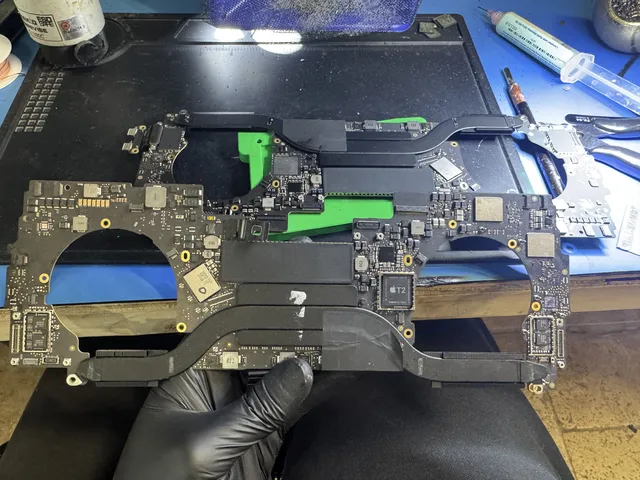
Heat pipes run across the logic board held above the bench in our Lincroft lab.
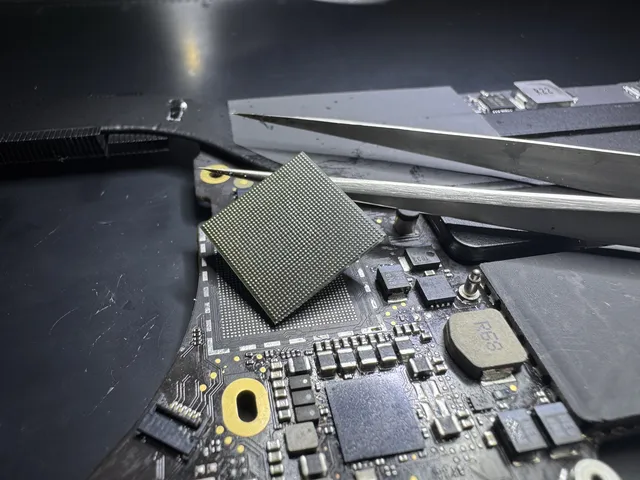
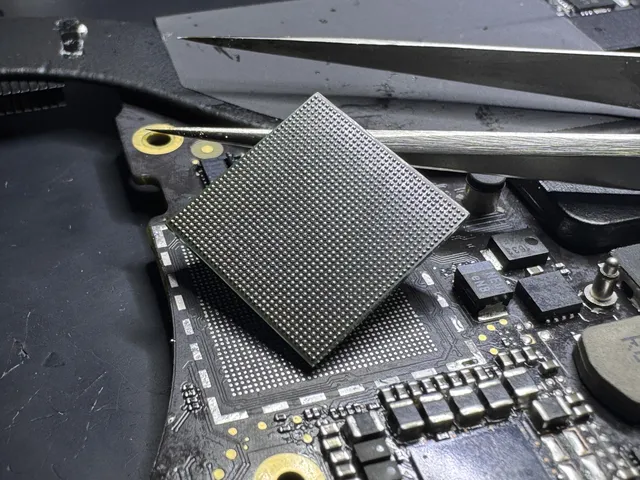
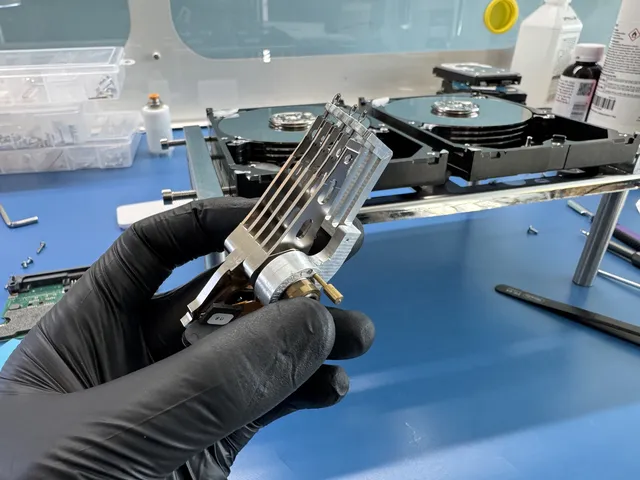
On the laptop board at our Lincroft bench, a lifted chip leaves its pads exposed beneath the tweezers.The exposed pads show where the chip sat on this laptop board at our Lincroft bench.Behind the microscope in our Lincroft lab are a power supply, soldering station and parts drawers.
2M+Social Media Followers
4.6 ★Average Rating
$100Flat Diagnostic Fee
FreeShipping Both Ways
No DataNo Charge
All 50States Served
Failure Types
Common MacBook Data Loss Scenarios in San Diego
Liquid Damage / Spill
Coffee, water, and beverage spills are the number one killer of MacBooks - and the leading cause of data loss we see in our lab. Liquid seeps under BGA components, corrodes solder joints, and shorts critical power rails on the logic board. The damage is often progressive: a MacBook that works fine after a spill can die days later as corrosion spreads. Our technicians perform ultrasonic cleaning, remove corrosion under a stereo microscope, and micro-solder replacement components to restore board function and data access. When board-level repair alone can bring the Mac back to life, that's the fastest and most cost-effective path to your files.
T2 Security Chip Failure
The Apple T2 chip in 2018-2020 Intel MacBooks acts as the SSD controller and hardware encryption engine - every byte of data on the NAND is encrypted through it. When the T2 fails due to firmware corruption, power surge, or liquid damage, the Mac sees no storage device at all. There is no software workaround. Our lab uses specialized hardware diagnostic tools to interface with the T2 at the board level and restore communication between the chip and NAND. If the T2 itself is beyond repair but the CPU, NAND, and EEPROMs survived, we perform a CPU/NAND/EEPROM swap to a known-good donor board - transplanting the critical components that hold your encryption keys and data to a working motherboard.
Apple Silicon Crash / Failure
On M1, M2, M3, and M4 Macs, Apple moved the SSD controller and Secure Enclave directly into the processor itself. That means when an Apple Silicon chip fails, your storage is completely inaccessible - there is no secondary path to the NAND. Chip-off extraction does not work here because the data is hardware-encrypted and the decryption keys live in the CPU's Secure Enclave. Our recovery method for catastrophic Apple Silicon failure is a CPU/NAND/EEPROM swap: we transplant the original CPU (which holds the encryption keys), NAND packages, and EEPROMs to a donor working motherboard. As long as the CPU silicon survived, your data is recoverable.
FileVault Locked / Recovery Key Lost
FileVault full-disk encryption on macOS is tied to the T2 chip or Apple Silicon Secure Enclave - not just your password. If you've lost your FileVault recovery key and can't log in, or if a firmware update corrupted the encryption state, most shops will tell you the data is gone. Our lab works at the hardware level to restore the authentication pathway between the security processor and the encrypted NAND. In many cases, we can repair the board-level failure preventing FileVault from unlocking and recover your data without the recovery key, as long as the security hardware that holds the encryption keys is intact.
Kernel Panic / No Boot Loop
Repeating kernel panics, the flashing question mark folder, the spinning globe that never loads, or an infinite reboot loop - these symptoms mean your MacBook can't find or load its operating system. Your data is almost certainly still on the NAND, but you can't get to it because storage is soldered to the logic board and can't be removed and plugged into another machine. Our technicians bypass the boot process entirely, diagnose whether the failure is a corrupted file system, failing NAND block, or a board-level hardware fault, and extract your data directly at the hardware level without relying on macOS to boot.
SSD Controller Failure
The storage controller - built into the T2 chip on Intel Macs or the Apple Silicon SoC on M-series Macs - manages every read and write to the soldered NAND flash. When this controller fails, the Mac reports no internal storage in Disk Utility, Recovery Mode, and even DFU mode. The NAND chips still hold your data, but nothing on the board can talk to them. Our first approach is always board-level repair to restore controller function. If the controller is permanently dead, we perform a CPU/NAND/EEPROM swap - moving the storage chips, CPU, and supporting components to a working donor board that can communicate with the NAND and decrypt your data.
Logic Board Failure
A dead logic board doesn't necessarily mean dead data. Power delivery failures, blown capacitors, shorted ICs, and failed voltage regulators can all kill a MacBook while leaving the NAND and CPU completely intact. Our technicians diagnose the exact point of failure using board schematics, thermal imaging, and micro-probing under a stereo microscope. When the fault is repairable - a blown MOSFET, corroded connector, or failed power IC - we micro-solder the fix and restore full data access. For catastrophic board damage where repair isn't viable, we perform a CPU/NAND/EEPROM swap to a donor motherboard, preserving the encryption relationship between your CPU's Secure Enclave and NAND storage.
Accidental Deletion / Failed Time Machine
Emptied the Trash, erased the wrong APFS volume, ran a clean macOS install over your data, or lost your only Time Machine backup? On MacBook SSDs with TRIM enabled, deleted data has a ticking clock - once TRIM processes the deleted blocks, the NAND physically erases them and the data is gone for good. The critical step is to stop using the Mac immediately. If you act fast and the TRIM garbage collection hasn't completed, we can recover deleted files by reading the NAND at the hardware level before the blocks are wiped. Time is the single biggest factor in these cases - contact us before powering the Mac on again.
Physical Drop / Impact Damage
A dropped or crushed MacBook can suffer internal component displacement, cracked solder joints on the logic board, and fractured NAND packages - even when the external case looks fine. Impact forces flex the logic board and can break the microscopic solder connections between BGA chips and the PCB, killing power delivery or storage communication. Our technicians diagnose impact damage using X-ray imaging and stereo microscope inspection to identify cracked joints, displaced chips, and hairline PCB fractures invisible to the naked eye. We then micro-solder the damaged connections, reball BGA components, or perform a CPU/NAND/EEPROM swap if the board damage is too extensive to repair in place.
How It Works
How Your MacBook Recovery Works
01
Free Consultation
Call 732-933-7717 or submit our secure online form. Tell us what happened - liquid spill, no power, kernel panic, FileVault lock - and a recovery engineer will walk you through your options, expected timeline, and pricing range. You generate a free prepaid UPS label on the mail-in form (contiguous US) so your MacBook or bare logic board arrives safely at our lab.
02
$100 Board-Level Diagnostic
At our Lincroft, NJ lab, we put your MacBook under the microscope - literally. Using BGA rework stations and PC-3000 diagnostic platforms, we trace the failure to the exact component: T2 or Apple Silicon processor, NAND flash, power management IC, or liquid corrosion path. You receive a detailed diagnostic report and a firm, no-surprise quote before we touch a single solder joint.
03
Precision Recovery
Our engineers execute the recovery using Apple-specific board-level techniques refined across hundreds of MacBook cases. Depending on the failure, that means repairing the logic board to restore native data access, bypassing T2/Apple Silicon encryption at the hardware level, or performing a CPU/NAND/EEPROM transplant to a known-good donor board when the original board is beyond repair. Every step is performed under magnification with medical-grade precision.
04
Verification & Return
Every recovered file is verified for integrity - documents open, photos render, videos play without artifacts. Your data is transferred to a new external drive and shipped back with free shipping (contiguous US). No data, no charge: if we can't recover your target files, you pay only the $100 diagnostic fee.
Free shipping (contiguous US) from San Diego CA - $100 diagnostic - no data, no charge.
MacBook data recovery pricing for San Diego, CA customers depends on the failure type, Mac model, and complexity of the storage architecture. San Diego residents ship their MacBook to our Lincroft, NJ lab using free shipping labels (contiguous US) - transit from California typically takes 2-3 business days each way. Logical recoveries from bootable boards cost less than T2 chip bypass or CPU/NAND/EEPROM transplant from liquid-damaged logic boards. Every case includes our $100 flat-rate diagnostic - no surprises, no hidden fees.
Standard
$1,500
Logical and software-level recovery for MacBooks with functional hardware. Covers accidental deletion, file system corruption, failed macOS updates, and APFS volume repair on boards that still power on and pass diagnostics.
APFS file system repair
Deleted file recovery
macOS corruption repair
Time Machine data extraction
Free return shipping
Advanced
$1,500
Board-level hardware recovery for MacBooks with component failures, repairable liquid damage, or encrypted storage requiring T2/Apple Silicon bypass. We repair the logic board at the component level to restore native data access.
T2 / Apple Silicon bypass
Board-level component repair
FileVault encrypted recovery
Liquid damage board restoration
Free return shipping
Critical
$3,500+
CPU, NAND, and EEPROM transplant for MacBooks with catastrophic logic board failure or irreparable liquid damage. The CPU holds the Secure Enclave decryption keys - if the CPU survived, we transplant it along with the NAND and EEPROM to a known-good donor motherboard to unlock and recover your data.
Apple Mac Models We Recover for San Diego Customers
MDRepairs recovers data from every Mac with soldered or integrated storage - MacBook Pro, MacBook Air, iMac, Mac Mini, Mac Studio, and Mac Pro. Whether you purchased your Mac from an Apple Store, Best Buy, or online and you're located in San Diego, California, our Lincroft NJ lab has the board-level expertise and specialized tools to recover data from Apple's proprietary storage architecture, T2 security chip, and Apple Silicon processors. Below is a comprehensive list of Mac models we recover data from for San Diego customers.
Era 01
Removable PCIe SSD
3 models
MacBook Pro 13" (2015) - Intel, Removable PCIe SSD
MacBook Pro 15" (2015) - Intel, Removable PCIe SSD
MacBook Air 13" (2013-2017) - Intel, Removable PCIe SSD
Era 02
Soldered SSD
7 models
MacBook Pro 13" (2016) - Intel, Touch Bar, Soldered SSD
MacBook Pro 13" (2017) - Intel, Touch Bar, Soldered SSD
MacBook Pro 15" (2016) - Intel, Touch Bar, Soldered SSD
MacBook Pro 15" (2017) - Intel, Touch Bar, Soldered SSD
MacBook Pro 14" (2021) - Apple M1 Pro / M1 Max, Soldered SSD
MacBook Pro 14" (2023) - Apple M2 Pro / M2 Max, Soldered SSD
MacBook Pro 14" (2023) - Apple M3, Soldered SSD
MacBook Pro 14" (2023) - Apple M3 Pro / M3 Max, Soldered SSD
MacBook Pro 14" (2024) - Apple M4, Soldered SSD
MacBook Pro 14" (2024) - Apple M4 Pro / M4 Max, Soldered SSD
MacBook Pro 16" (2021) - Apple M1 Pro / M1 Max, Soldered SSD
MacBook Pro 16" (2023) - Apple M2 Pro / M2 Max, Soldered SSD
MacBook Pro 16" (2023) - Apple M3 Pro / M3 Max, Soldered SSD
MacBook Pro 16" (2024) - Apple M4 Pro / M4 Max, Soldered SSD
MacBook Air 13" (2020) - Apple M1, Soldered SSD
MacBook Air 13" (2022) - Apple M2, Soldered SSD
MacBook Air 13" (2024) - Apple M3, Soldered SSD
MacBook Air 15" (2023) - Apple M2, Soldered SSD
MacBook Air 15" (2024) - Apple M3, Soldered SSD
iMac 24" (2021) - Apple M1, Soldered SSD
iMac 24" (2023) - Apple M3, Soldered SSD
iMac 24" (2024) - Apple M4, Soldered SSD
Mac Mini (2020) - Apple M1, Soldered SSD
Mac Mini (2023) - Apple M2 / M2 Pro, Soldered SSD
Mac Mini (2024) - Apple M4 / M4 Pro, Soldered SSD
Mac Studio (2022) - Apple M1 Max / M1 Ultra, Soldered SSD
Mac Studio (2023) - Apple M2 Max / M2 Ultra, Soldered SSD
Mac Studio (2024) - Apple M4 Max, Soldered SSD
Mac Pro (2023) - Apple M2 Ultra, Soldered SSD
Era 05
Fusion Drive / Modular SSD
4 models
iMac 21.5" (2017) - Intel, SSD / Fusion Drive
iMac 21.5" (2019) - Intel, SSD / Fusion Drive
iMac 27" (2017) - Intel, SSD / Fusion Drive
Mac Pro (2019) - Intel Xeon W, Modular SSD
Storage Architecture3 sections
01
MacBook Storage Architecture: From Removable SSDs to Soldered NAND - San Diego
Understanding why MacBook data recovery is fundamentally different from PC laptop recovery starts with Apple's storage architecture decisions. For San Diego residents who depend on their MacBooks daily, this context matters because it determines what kind of recovery is even possible when your Mac fails.
Before 2016, most MacBooks used removable PCIe SSDs - proprietary Apple connectors, but physically removable. A technician could pull the SSD module, connect it to another Mac using a third-party adapter, and access the data. Starting in 2016 with the MacBook Pro Touch Bar models, Apple began soldering NAND flash storage directly to the logic board. By 2018, with the introduction of the T2 security chip, Apple also encrypted every byte of data at the hardware level - even if you could desolder the NAND, you couldn't read it without the T2 chip that holds the encryption keys.
Continue reading2 more paragraphs
For San Diego, California users, this means that when your post-2016 MacBook fails, there is no 'just pull the drive out' option. The storage is part of the logic board. Recovery requires either repairing the board to restore native data access, or performing a component-level transplant (CPU, NAND, EEPROMs) to a donor board. Both approaches require board-level micro-soldering expertise and specialized diagnostic equipment that general computer repair shops in San Diego simply don't have.
Our Lincroft, NJ lab handles these recoveries daily. We work with the full range of Apple storage architectures - from older removable PCIe SSDs to the latest M4 processors with fully integrated storage controllers. San Diego customers ship their MacBook to us using free labels (contiguous US), and we diagnose exactly which storage architecture your Mac uses and the most effective recovery path for your specific failure.
02
T2 Security Chip and Data Recovery Challenges - San Diego CA
The Apple T2 security chip, introduced in 2018, created one of the most challenging data recovery scenarios in the industry. For San Diego, California MacBook users with 2018-2020 Intel models, understanding the T2 is critical because it controls everything about your data's accessibility.
The T2 chip serves as the SSD controller, hardware encryption engine, and secure boot manager all in one. Every byte written to the soldered NAND flash passes through the T2's encryption pipeline - AES-256 hardware encryption that runs constantly, transparently, and cannot be disabled. When the T2 fails due to firmware corruption, liquid damage, or electrical fault, the Mac reports no internal storage. The NAND still holds your data, but without a functioning T2 to decrypt it, the data is cryptographically locked.
Continue reading3 more paragraphs
For San Diego residents, this means that if your 2018-2020 MacBook Pro or MacBook Air shows the flashing question mark folder, won't boot to Recovery Mode, or reports no startup disk in Disk Utility, you likely have a T2 failure. No software tool, no Apple Store visit, and no local repair shop in San Diego can bypass this. The recovery must happen at the hardware level.
Our lab's T2 recovery process involves board-level diagnostics to determine whether the T2 failure is repairable (firmware reflash, power rail repair, liquid damage remediation) or whether a CPU/NAND/EEPROM transplant to a donor board is required. In both cases, the goal is the same: restore the T2's ability to communicate with the NAND and decrypt your data. San Diego customers mail their MacBook to our Lincroft lab and receive a detailed diagnostic report before any recovery work begins.
T2-related recoveries typically fall into our Advanced ($1,500) or Critical ($3,500+) pricing tiers depending on whether the T2 itself can be repaired or whether a full component transplant is needed.
03
Apple Silicon (M1/M2/M3/M4) Data Recovery for San Diego Customers
Apple Silicon - the M1, M2, M3, and M4 processors - represents the most tightly integrated storage architecture Apple has ever built. For San Diego Mac users, this integration has major implications for data recovery when things go wrong.
Unlike Intel Macs with T2 chips (where the T2 was a separate chip from the CPU), Apple Silicon combines the CPU, GPU, Neural Engine, SSD controller, and Secure Enclave into a single system-on-chip. The NAND flash is still soldered to the logic board separately, but the controller that manages it and the encryption keys that protect it are inside the M-series processor. If the processor dies, there is no secondary path to the NAND. Chip-off extraction alone doesn't work because the data is encrypted and the keys died with the processor - unless the CPU silicon itself survived the failure.
Continue reading2 more paragraphs
This is where CPU/NAND/EEPROM transplant becomes the only viable recovery method. Our technicians desolder the M-series processor (which contains the Secure Enclave and encryption keys), the NAND flash packages, and the supporting EEPROMs from the failed logic board. All components are transplanted to a known-good donor motherboard. Because the original CPU retains its Secure Enclave keys and the NAND contains data encrypted by that specific CPU, the donor board boots with full data access.
For San Diego, CA residents with a dead M1/M2/M3/M4 MacBook - no power, no screen, no response - the critical question is whether the CPU silicon survived. If it did, your data is recoverable through transplant. Our Lincroft lab performs this assessment as part of the $100 diagnostic. Ship your Mac to us from San Diego using free labels (contiguous US) and we'll determine exactly what's possible.
Every Mac We Recover3 sections
04
MacBook Pro Data Recovery - San Diego CA
The MacBook Pro is the most common Mac we recover data from, and San Diego users own every generation - from the 2015 models with removable PCIe SSDs to the latest M4 Pro and M4 Max 14-inch and 16-inch machines with fully soldered storage.
MacBook Pro 13-inch models (2016-2022) use either Intel processors with T2 chips or Apple M1/M2 silicon. The 14-inch models (2021-present) run M1 Pro, M2 Pro, M3, M3 Pro, M4, and M4 Pro chips. The 15-inch models (2016-2019) are Intel with T2, while the 16-inch spans from Intel T2 (2019) through M1 Max, M2 Max, M3 Max, and M4 Max. Each generation has slightly different board layouts, NAND configurations, and recovery approaches.
Continue reading2 more paragraphs
San Diego professionals who use MacBook Pros for creative work, software development, video editing, or business operations often store hundreds of gigabytes locally - project files, client deliverables, databases, and proprietary data that may not be fully backed up to iCloud or Time Machine. When a MacBook Pro fails, the recovery urgency is real.
Our Lincroft lab maintains donor boards for every MacBook Pro generation to support CPU/NAND/EEPROM transplants when board-level repair isn't viable. San Diego customers benefit from free shipping both ways (contiguous US) - your MacBook Pro arrives safely at our lab and your recovered data ships back on a new external drive.
05
MacBook Air Data Recovery for San Diego Residents
MacBook Air models are increasingly popular among San Diego students, remote workers, and everyday users who prioritize portability. The Air's thin design makes it more vulnerable to certain types of damage - particularly liquid spills and flex-related solder joint fractures from being carried in bags daily.
The MacBook Air 13-inch (2018-2020 Intel) uses the T2 security chip with soldered NAND. The M1 Air (2020), M2 Air (2022), and M3 Air (2024) use Apple Silicon with integrated storage controllers. The 15-inch Air (2023-2024) runs M2 and M3 chips. All of these have soldered storage that cannot be removed for standalone data access.
Continue reading2 more paragraphs
We see a high volume of MacBook Air liquid damage cases because the thin chassis provides minimal protection against spills. Coffee, water, and beverages reach the logic board quickly and cause corrosion on critical power delivery and storage communication traces. For San Diego MacBook Air users, the key is to stop using the machine immediately after a spill - don't try to dry it with rice, don't plug it in, don't attempt to power it on.
Ship your damaged MacBook Air to our Lincroft, NJ lab from San Diego using our free shipping labels (contiguous US). Our technicians will assess the liquid damage under magnification and determine whether board-level repair or component transplant is the best path to your data. Call 732-933-7717 for a free consultation.
06
iMac, Mac Mini, and Mac Studio Recovery - San Diego CA
Desktop Macs - iMac, Mac Mini, and Mac Studio - present the same soldered storage challenge as MacBook laptops once they moved to Apple Silicon. San Diego users who rely on desktop Macs for creative production, business operations, or home office work face the same recovery requirements when these machines fail.
The iMac 24-inch (2021-present) uses M1, M3, and M4 chips with soldered NAND. Older Intel iMacs (2017-2020) used Fusion Drives or standalone SSDs - some removable, some soldered with T2 encryption. The Mac Mini transitioned from Intel T2 (2018) to M1 (2020), M2/M2 Pro (2023), and M4/M4 Pro (2024), all with soldered storage. The Mac Studio (2022-present) runs M1 Max/Ultra through M4 Max with soldered NAND containing massive storage configurations up to 8TB.
Continue reading2 more paragraphs
For San Diego desktop Mac users, shipping a full iMac to our lab is straightforward - you generate a free prepaid UPS label on the mail-in form (contiguous US) that cover the cost. Mac Minis and Mac Studios are small enough to pack easily. In some cases, particularly with older iMacs where the logic board can be removed, San Diego customers can ship just the logic board to reduce shipping weight and size.
Our Lincroft lab recovers data from desktop Macs using the same board-level techniques we apply to MacBook laptops - board repair, T2 bypass, Apple Silicon CPU/NAND/EEPROM transplant. The recovery process and pricing are identical regardless of Mac form factor. Call 732-933-7717 from San Diego to get started.
Inside the Lab4 sections
07
FileVault Encryption and MacBook Data Recovery - San Diego CA
FileVault full-disk encryption is enabled by default on modern Macs, and most San Diego users don't even realize their data is encrypted until something goes wrong. FileVault uses the T2 chip or Apple Silicon Secure Enclave to manage encryption keys - your login password unlocks the keys, but the actual encryption is handled in hardware.
The most common FileVault recovery scenario we see from San Diego customers involves a Mac that won't boot, combined with a lost or forgotten FileVault recovery key. Without the recovery key and without a functioning boot process, the standard Apple recovery paths (Recovery Mode, Target Disk Mode, DFU restore) all fail. The data is encrypted and the Mac can't authenticate the user to unlock it.
Continue reading3 more paragraphs
Our lab approaches FileVault recovery from the hardware side. If the T2 or Apple Silicon processor is functional but the Mac won't boot due to a separate board failure (power delivery, display circuit, keyboard controller), we repair the specific failed component to restore boot capability and FileVault authentication. If the security processor itself has partially failed, we attempt firmware-level repair to restore its authentication function.
For San Diego Mac users with FileVault-encrypted machines, the most important thing is to not attempt a macOS reinstall or disk erase - these actions can destroy the encryption key relationship and make recovery impossible. Ship your Mac to our Lincroft lab in its current state. We'll assess the FileVault situation as part of our $100 diagnostic and provide a clear recovery path before proceeding.
If you still have your FileVault password and the Mac simply won't boot, recovery is typically faster and less expensive because we can authenticate once we repair the board-level fault preventing startup. Call 732-933-7717 from San Diego to discuss your specific FileVault situation.
08
Liquid Damage MacBook Recovery - San Diego CA
Liquid damage is the single most common cause of MacBook data loss we see from San Diego customers. Coffee spills, water damage, pet accidents, and beverage mishaps send liquid directly through the keyboard and onto the logic board, where it immediately begins corroding solder joints, traces, and component pads.
The damage timeline matters enormously. The moment liquid contacts the logic board, electrochemical corrosion begins. Within hours, corrosion can spread along copper traces and reach critical components - the T2 chip, Apple Silicon processor, NAND flash connections, and power management ICs. Every hour the board stays wet and powered accelerates the damage. This is why we tell San Diego MacBook users: power off immediately, don't plug it in, don't put it in rice (rice doesn't stop corrosion and can introduce starch particles into the board), and ship it to our lab as quickly as possible.
Continue reading2 more paragraphs
Our liquid damage recovery process begins with ultrasonic cleaning to remove all liquid residue, followed by detailed inspection under a stereo microscope at up to 50x magnification. We trace every corrosion path to identify which components and traces are damaged. Micro-soldering repairs - replacing corroded resistors, capacitors, and ICs, and bridging broken traces with copper wire jumpers - restore board function in many cases.
When liquid damage is too extensive for board repair - multiple BGA components corroded, critical traces destroyed, T2 or Apple Silicon processor damaged - we move to CPU/NAND/EEPROM transplant. As long as the CPU die and NAND packages survived the liquid exposure, we can transplant them to a clean donor board. San Diego customers ship their liquid-damaged MacBook to our Lincroft lab using free labels (contiguous US). The sooner it arrives, the better the recovery outcome - call 732-933-7717 immediately after a spill.
09
Logic Board Failure and Data Access - San Diego CA
A dead logic board is not the same as dead data. San Diego MacBook users often assume that when their Mac won't power on, their data is gone. In reality, the NAND flash storage and CPU (which holds the encryption keys) may be perfectly intact - the failure is in the power delivery, voltage regulation, or supporting circuitry that prevents the board from initializing.
Common logic board failures include blown power management ICs (PMIC), failed USB-C port controllers that prevent charging, shorted capacitors on critical voltage rails, and failed GPU or display output circuits that make the Mac appear dead when it's actually running but can't show output. Our technicians diagnose these failures using board schematics, thermal imaging cameras, and micro-probing under magnification.
Continue reading2 more paragraphs
For San Diego customers, the diagnostic process is the key step. Our $100 flat-rate diagnostic identifies the exact point of failure on the logic board - which specific component failed, which voltage rail is down, and whether the fault is repairable. If the failure is a blown MOSFET, corroded connector, or failed power IC, we micro-solder the replacement and restore the Mac to a bootable state where data can be extracted normally.
When the logic board damage is catastrophic - multiple components destroyed, board physically cracked, or fire/severe liquid damage - we extract the CPU, NAND packages, and EEPROMs and transplant them to a donor board. The data recovery outcome depends on the condition of these three component groups, not the overall board condition. Ship your dead MacBook from San Diego to our Lincroft lab - a dead board doesn't mean dead data. Call 732-933-7717.
10
NAND Chip-Off Recovery for Apple Devices - San Diego CA
NAND chip-off recovery is a last-resort technique where the NAND flash packages are physically desoldered from the logic board and read directly using specialized hardware. For San Diego Mac users, it's important to understand when chip-off applies and when it doesn't - because on modern Macs, chip-off alone is not sufficient due to hardware encryption.
On older Macs without T2 chips (pre-2018 Intel models without FileVault), NAND chip-off can work as a standalone recovery method. The NAND packages are desoldered using a BGA rework station, placed into a chip reader, and the raw data is reconstructed from the NAND pages. This bypasses the entire logic board - useful when the board is destroyed beyond repair and no CPU transplant is needed.
Continue reading2 more paragraphs
On T2-equipped Macs (2018-2020 Intel) and Apple Silicon Macs (M1-M4), the NAND data is hardware-encrypted. Reading the NAND chips directly produces only encrypted data that cannot be decrypted without the T2 or Apple Silicon Secure Enclave that holds the keys. This is why we perform CPU/NAND/EEPROM transplant rather than standalone chip-off on modern Macs - the CPU must accompany the NAND to a donor board to maintain the encryption key relationship.
Our Lincroft lab uses precision BGA rework stations with model-specific thermal profiles to desolder NAND packages without thermal damage to the silicon dies inside. For San Diego customers with older unencrypted Macs, standalone chip-off may be the fastest path to recovery. For modern encrypted Macs, chip-off is performed as part of a larger CPU/NAND/EEPROM transplant procedure. We determine which approach your Mac requires during the $100 diagnostic. Call 732-933-7717 from San Diego.
Good to Know3 sections
11
Mac vs. PC Data Recovery - Key Differences for San Diego Customers
Mac data recovery and PC data recovery are fundamentally different disciplines, and San Diego customers who've had a PC hard drive or SSD recovered before may not realize how much more complex Mac recovery is. The differences come down to three factors: storage architecture, encryption, and repairability.
On a typical PC laptop, the SSD is a standard M.2 NVMe drive that plugs into a socket. If the laptop dies, you remove the SSD, plug it into any other computer with an NVMe adapter, and your data is right there (assuming no BitLocker encryption). The SSD is an independent, removable component. Recovery from a failed SSD itself involves controller repair or NAND chip-off using standardized tools and publicly documented controller architectures.
Continue reading2 more paragraphs
On a Mac, the SSD is soldered to the logic board and encrypted through a proprietary security chip. You cannot remove it. You cannot plug it into another machine. The encryption keys live in the T2 chip or Apple Silicon processor, not on the NAND itself. Recovery requires either repairing the original board to restore native access, or transplanting the CPU/NAND/EEPROMs to a compatible donor board - a procedure that requires Apple-specific board schematics, model-specific donor parts, and BGA-level micro-soldering skills.
For San Diego residents, this means that the local computer repair shop that successfully recovered your PC hard drive data likely cannot handle a MacBook recovery. It's a completely different skill set, toolset, and knowledge base. Our Lincroft lab specializes in Mac data recovery at the board level - it's one of our core specialties, not a sideline service. Call 732-933-7717 to discuss your San Diego Mac recovery case.
12
Preventing MacBook Data Loss - San Diego: Time Machine, iCloud, and Backups
While our Lincroft lab is here to recover data when the worst happens, San Diego Mac users can significantly reduce their risk of permanent data loss with a proper backup strategy. Apple provides several built-in tools, but each has limitations that many users don't understand until it's too late.
Time Machine is Apple's built-in backup solution. It creates hourly, daily, and weekly snapshots to an external drive. The limitation: Time Machine only runs when the external drive is connected. If you're a San Diego professional who uses your MacBook on the go and only plugs in the Time Machine drive occasionally, you could lose weeks of work between backups. For reliable Time Machine coverage, keep the backup drive connected whenever you're at your desk.
Continue reading2 more paragraphs
iCloud Drive syncs documents, photos, and desktop files to Apple's cloud - but it's not a true backup. iCloud sync means that if you delete a file on your Mac, it's deleted from iCloud too. If malware corrupts files on your Mac, corrupted versions sync to iCloud. And iCloud storage is limited by your subscription tier - many San Diego users run out of space and don't realize files have stopped syncing.
The most reliable backup strategy for San Diego Mac users combines Time Machine for local versioned backups, iCloud for cloud sync, and a third-party cloud backup service (like Backblaze or Carbonite) for true offsite backup. This three-layer approach ensures that even if your MacBook, your Time Machine drive, and your iCloud account all fail simultaneously, you still have an offsite copy of everything. But if it's already too late and you need recovery now - call 732-933-7717.
13
Apple APFS File System and Recovery Considerations - San Diego CA
Apple File System (APFS) replaced HFS+ in 2017 and is now the default file system on every Mac. For San Diego Mac users, understanding APFS matters for data recovery because it handles data differently than older file systems - and some of those differences make recovery harder.
APFS uses copy-on-write, space sharing between volumes, strong encryption integration, and snapshot support. These features improve daily performance and reliability, but they complicate recovery when the file system itself becomes corrupted. Unlike HFS+, where file catalog corruption often left data blocks intact and recoverable through catalog reconstruction, APFS corruption can affect the space-sharing metadata that multiple volumes depend on, potentially impacting more data than the original fault.
Continue reading3 more paragraphs
TRIM adds another layer of complexity. On SSDs (including all soldered Mac storage), TRIM tells the controller to erase data blocks that the file system has marked as deleted. This happens automatically in the background. For San Diego users who accidentally delete files, the TRIM garbage collection process can permanently erase the deleted data within minutes to hours - making fast action essential. Power off the Mac immediately and contact us before TRIM runs.
APFS snapshots can sometimes help recovery. macOS creates local snapshots automatically, and these snapshots can preserve earlier versions of files even after deletion or corruption - but only if the Mac hasn't run out of space and pruned old snapshots. Our lab can access and extract data from APFS snapshots during the recovery process.
For San Diego Mac users experiencing APFS corruption - Disk Utility errors, volumes that won't mount, First Aid failures - don't attempt to reformat or reinstall macOS. Ship your Mac to our Lincroft lab and let our engineers assess the file system damage. APFS corruption is often recoverable when handled at the hardware level with direct NAND access. Call 732-933-7717.
Turnaround
Turnaround Time
Standard turnaround is 4-5 weeks for MacBook data recovery. San Diego, CA customers ship their MacBook to our Lincroft, NJ lab using free shipping labels (contiguous US) - transit from California typically takes 2-3 business days. Your MacBook enters our diagnostic queue upon arrival. You'll receive a detailed diagnostic report and firm quote before any recovery work begins. Rush options are available for time-sensitive cases - call 732-933-7717 to discuss expedited service.
Free shipping (contiguous US) from San Diego CA - $100 diagnostic - no data, no charge.
MacBook Data Recovery in San Diego - Our Lab & Expertise
See how our Lincroft, NJ data recovery lab handles real MacBook cases - the same equipment, techniques, and expertise we use for every recovery from San Diego, CA customers.
Inside the MDRepairs Data Recovery Lab
Lab Tour - Professional Recovery Equipment & Cleanroom
Failure
This video provides a complete tour of our Lincroft, NJ data recovery lab, showing the specialized equipment and cleanroom environment we use for every recovery case. You'll see the same professional tools, precision microscopes, and board-level diagnostic stations that our technicians use daily.
Recovery
Our lab is equipped with PC-3000 diagnostic platforms, BGA rework stations, stereo microscopes, and a certified cleanroom for handling sensitive media. Every device that arrives at MDRepairs - regardless of type - is processed through this same professional environment with the same level of care and precision you see in the video.
Data Recovery Process - From Diagnosis to Data Delivery
Real Recovery Case - Professional Workflow Demonstration
Failure
Watch a real data recovery case from start to finish in our lab. This video demonstrates the step-by-step diagnostic and recovery process our technicians follow for every case - careful device inspection, board-level diagnostics, component-level repair, and verified data extraction.
Recovery
The precision techniques, specialized tooling, and methodical approach shown in this video are the same procedures we apply to every recovery case in our lab. From initial assessment through final data verification and secure delivery, each step follows our established recovery protocol to maximize the chances of a successful outcome.
T2 Chip MacBook Pro Recovery - Liquid Damage Board-Level Repair
MacBook Pro 2020 13-inch (Intel, T2 Chip)
Failure
The owner spilled an entire glass of water across the keyboard of their 2020 MacBook Pro 13-inch while working late at night. The machine immediately shut down and would not power on afterward. They made the common mistake of placing the MacBook in rice for 48 hours before attempting to power it on, which did nothing to address the internal corrosion already spreading across the logic board. By the time the MacBook arrived at our lab, visible corrosion was present on multiple board components near the keyboard connector, including traces running to the T2 security chip. Apple Store inspection declared the machine a total loss - logic board replacement at $799 with all data lost. The owner had 4 years of graduate research data, a completed thesis draft, thousands of research photos from fieldwork, and personal documents spanning a decade.
Recovery
Our board-level inspection under 50x magnification revealed corrosion on three critical trace paths between the T2 chip and the NAND flash packages, plus a corroded resistor in the T2 power delivery circuit. We ultrasonically cleaned the entire board, then performed micro-soldering repairs on the damaged traces using 0.1mm copper wire jumpers under the microscope. The corroded resistor was replaced with a matching component from a donor board. After repair, the T2 chip initialized successfully and we gained read access to the encrypted NAND storage. We imaged the complete 512GB volume, decrypted it with the client's FileVault password, and verified all files. Complete recovery - thesis, research data, fieldwork photos, and 10 years of personal documents. Total repair and extraction time was 12 days.
MacBook Air M1 CPU/NAND Swap - Catastrophic Board Failure Recovery
MacBook Air 2020 (Apple M1, 256GB)
Failure
A 2020 MacBook Air M1 was plugged into a faulty third-party USB-C charger that delivered an overvoltage spike, destroying the M1 processor's power management circuitry and rendering the entire logic board non-functional. The machine showed zero signs of life - no LED indicator, no fan activity, no response to any key combination or SMC reset attempt. The M1 processor was confirmed dead through board-level probing. With the M1 dead, there was no conventional path to access the NAND flash storage because Apple Silicon integrates the storage controller, encryption engine, and Secure Enclave into the processor die. The owner - a freelance graphic designer - had her entire portfolio, active client projects in Adobe Illustrator and Photoshop, and 3 years of design assets totaling approximately 200GB stored locally with no external backup.
Recovery
With the M1 processor confirmed dead but the NAND flash packages, M1 CPU die, and EEPROMs physically intact, we proceeded with a CPU/NAND/EEPROM transplant - the correct recovery method for Apple Silicon Macs with destroyed logic boards. We carefully desoldered the M1 processor (which contains the Secure Enclave and its encryption keys), both NAND flash BGA packages, and the board EEPROMs from the dead logic board using our precision BGA rework station with Apple-specific thermal profiles. All three component groups were then transplanted onto a known-good donor MacBook Air M1 logic board. Because the original M1 CPU retained its Secure Enclave keys, and the original NAND packages contained the encrypted data written by that specific CPU, the donor board booted successfully with full access to the encrypted storage - the CPU, NAND, and EEPROMs functioned together exactly as they had on the original board. We imaged the complete volume and verified every file. Complete recovery of 193GB - full design portfolio, all active Illustrator and Photoshop project files, and the entire 3-year design asset library. Recovery time was 14 days.
The people we help
Our customers include people from
AT&T
Marriott
Tennessee Titans
AT&T
Marriott
Tennessee Titans
Reviews
What Our Customers Say
My 8Tb MacBook Pro crashed, w no backup. The Apple store wanted to replace the logicboard, which would destroy all my data; unacceptable. … MDRepairs did what the others told me was impossible. They saved every bit of data! This was a minor miracle.
John Baeke
Lost my SSD after a hard reset and i thought the world ended. … I paid the rush fee and within 24 hours and a few extra minutes my business came back to life like tragedy never struck in the first place. They saved everything i thought i lost.
miron trache
You recovered data from my corrupted external hard drive that was crucial to a major project. In fact, three other companies … said it was impossible, that the drive was too far gone. But not for MDrepairs!
Anisa Mehdi
I had an external hard drive crash. I took it to a local shop in Edmond, OK but they were unable to get hard drive up and running … Joe contacted me stating they recovered a little over 81,000 RAW Nikon NEF photo's
Ronald Eugene Estes (Ron)
I send it out to a couple shops out here in vegas, and they weren't able to fix. So later I gave up on it … So I saw the video on Facebook from MB repairs, and I decided to send it out to them. And they were able to recover every single music file.
Daniel Plascencia
Contacted MDRepairs for data extraction for an iPhone 5C and for an old hard drive. … The hard drive had a hard crash where it was clear something mechanical within the HDD had failed. … Regardless, both techs did an amazing job. The data was quickly recovered in just a few days.
Chris Hillerich
Trusted
San Diego's Professional Data Recovery Lab - 2M+ Followers Nationwide
MDRepairs has built one of the largest followings in the data recovery industry - over 2 million across YouTube, TikTok, and Instagram - by documenting real recoveries on camera with full transparency. Our founder Joseph Montanti shows MacBook recovery cases from initial teardown through final data extraction, so San Diego residents can see exactly how we handle liquid-damaged MacBook Pros, dead T2 chip boards, and Apple Silicon Macs with failed processors. When you're searching for MacBook data recovery from San Diego, CA, you're not trusting a faceless company - you're watching our actual work before you ship your device.
Our Lincroft, NJ lab serves San Diego and all of California through free mail-in service. Call 732-933-7717 to start your recovery.
FAQ
MacBook Data Recovery FAQ
Can you recover data from a MacBook with soldered storage in San Diego?
Yes. Every MacBook since 2016 has soldered NAND flash storage that cannot be removed conventionally. Our Lincroft, NJ lab recovers data from soldered storage through board-level repair or CPU/NAND/EEPROM transplant. San Diego customers ship their MacBook using free labels (contiguous US).
How much does MacBook data recovery cost for San Diego customers?
MacBook data recovery pricing ranges from $1,500 for software-level recovery, $1,500 for T2/Apple Silicon board-level recovery, and $3,500+ for CPU/NAND/EEPROM transplant cases. Every San Diego case starts with a $100 flat-rate diagnostic.
How long does MacBook data recovery take from San Diego?
Standard turnaround is 4-5 weeks. Shipping from San Diego, CA to our Lincroft, NJ lab takes 2-3 business days each way. Rush options are available for time-sensitive cases - call 732-933-7717.
Can you recover data from an M1, M2, M3, or M4 MacBook in San Diego?
Yes. Apple Silicon Macs require CPU/NAND/EEPROM transplant when the processor fails because the encryption keys and storage controller are inside the chip. Our lab performs these transplants for San Diego customers regularly. If the CPU silicon survived, your data is recoverable.
My MacBook got wet in San Diego - can you recover the data?
Liquid damage is the most common MacBook failure we see. Power off immediately, don't plug it in, and ship it to our lab as soon as possible. Our technicians ultrasonically clean the board, repair corrosion damage under microscope, and recover data from the soldered NAND. Call 732-933-7717.
Do I need to ship my MacBook from San Diego to your lab?
Yes - our data recovery lab is in Lincroft, NJ. You generate a free prepaid UPS label on the mail-in form (contiguous US) for San Diego customers. Most shipments from California arrive within 2-3 business days.
Can you recover data from a MacBook with T2 chip failure?
Yes. The T2 security chip controls SSD encryption on 2018-2020 Intel Macs. When it fails, the Mac reports no storage. Our lab recovers data by repairing the T2 at the board level or performing a CPU/NAND/EEPROM transplant to a donor board. San Diego customers ship to us with free labels (contiguous US).
What if my MacBook has FileVault encryption and I lost the recovery key?
If the T2 chip or Apple Silicon Secure Enclave is functional, we can often restore the authentication pathway through board-level repair - allowing FileVault to unlock without the recovery key. The hardware that holds the encryption keys must be intact. Contact us from San Diego at 732-933-7717.
Can you recover data from a MacBook that won't turn on?
A MacBook that won't power on usually has a logic board failure - not dead storage. The NAND and CPU are often intact. Our lab diagnoses the exact board-level fault (power IC, voltage rail, liquid corrosion) and either repairs it or transplants the CPU/NAND/EEPROMs to a donor board. San Diego customers get free shipping both ways (contiguous US).
Is there a data recovery lab in San Diego that handles MacBooks?
MacBook data recovery requires board-level micro-soldering expertise, Apple-specific diagnostic tools, and donor logic boards - capabilities that general repair shops don't have. Our Lincroft, NJ lab specializes in Mac recovery and serves San Diego through free mail-in service.
What Mac models do you recover data from for San Diego customers?
We recover data from every Mac with soldered or integrated storage: MacBook Pro (13/14/15/16-inch, 2015-2024), MacBook Air (13/15-inch, 2018-2024), iMac (21.5/24/27-inch), Mac Mini, Mac Studio, Mac Pro, and MacBook 12-inch. All models, all processors - Intel, T2, M1-M4.
What's the difference between MacBook data recovery and regular SSD recovery?
MacBook storage is soldered to the logic board and hardware-encrypted through Apple's T2 or Apple Silicon security chips. Unlike standard NVMe SSDs that can be removed and plugged into another machine, Mac recovery requires board-level repair or component transplant. It's a specialized discipline.
Can you recover data from a dropped MacBook?
Yes. Impact damage can crack solder joints, displace BGA components, and fracture PCB traces while leaving the NAND and CPU intact. Our lab uses microscope inspection to identify impact damage and performs micro-soldering repairs or component transplant. Ship your dropped MacBook from San Diego to our Lincroft lab.
Do you charge if you can't recover my data?
No data, no charge. If we cannot recover your target files, you pay only the $100 diagnostic fee. This policy applies to all San Diego MacBook recovery cases regardless of failure type or complexity. We provide a detailed diagnostic report explaining exactly what we found.
How do I start a MacBook data recovery case from San Diego?
Call 732-933-7717 or submit our online form. We'll discuss your MacBook's symptoms, provide free shipping labels (contiguous US), and have your Mac in our Lincroft, NJ lab within 2-3 days of shipping from San Diego. You'll receive a diagnostic report and firm quote before any recovery work begins.
No question matches that - it's probably faster to just ask us: (732) 933-7717 or .